Read time: 14 minutes
For years, creatine had an image problem.
It was filed under bodybuilder, bro science, the tub of white powder next to the protein shakers. Used for men who wanted bigger arms. Not something for women, and definitely not something anyone associated with health, longevity or, of all things, pregnancy.
That reputation has not aged well.
Creatine is now one of the most researched supplements in existence. There are hundreds of human trials, decades of safety data, and a much more interesting story emerging around women specifically - who were, predictably, left out of much of the early research.
Creatine is definitely more than a “drink more water and believe in yourself” supplement. There is real substance here. The harder question, as always, is the Claritti one: what does creatine actually do, how strong is the evidence for each claim, where does it matter most for women, and where has the wellness market started running ahead of the data?
Let’s get into it.
First, what does creatine actually do?
Creatine is a compound made from three amino acids: arginine, glycine and methionine. We make some of it ourselves, mostly through the liver and kidneys, and we also get it from animal foods such as meat and fish.
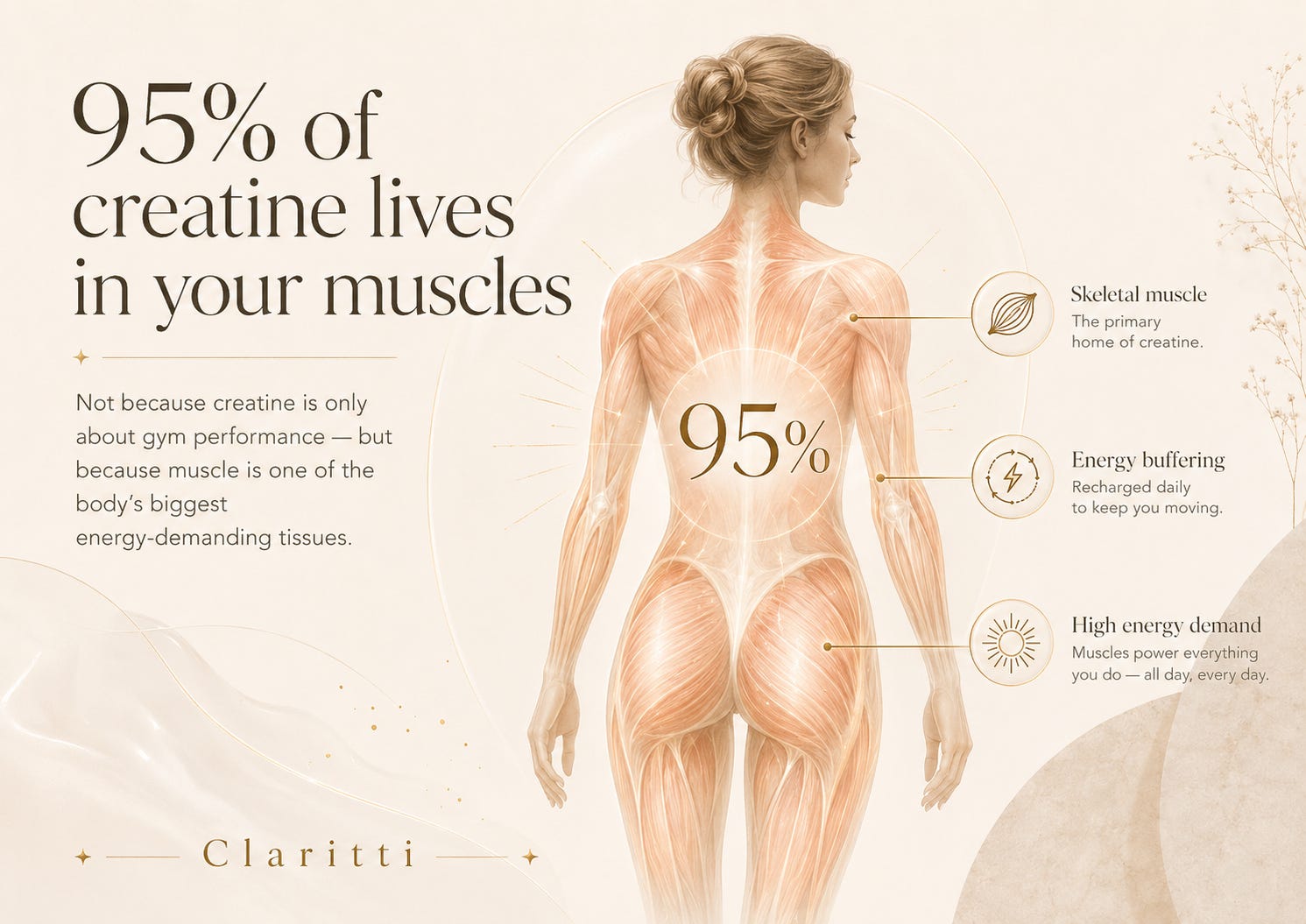
Around 95% of the creatine in the body is stored in skeletal muscle, with smaller amounts found in the brain and other high-energy tissues. Its main job is deceptively simple: it helps regenerate energy.
The currency cells use for quick energy is ATP. When a cell does work, it spends ATP. Creatine (stored as phosphocreatine) acts like a rapid recharging system, donating a phosphate to turn spent energy back into usable energy.
This matters most in tissues with high, sudden energy demands: muscle, the brain, and potentially, in a very different way, the placenta and fetus.
So at its core, creatine is an energy-system support tool, a buffer for cellular energy.
Hold onto that idea, because it explains almost everything that follows.
Why Women Are Not Just “Smaller Men” In Creatine Research
One of the most overlooked details in the literature is that creatine physiology differs by sex.
A major review on creatine across the female lifespan notes that females have around 70–80% lower endogenous creatine stores compared with males, and that women also tend to consume less dietary creatine. The same review argues that creatine may be particularly relevant during life stages where hormones alter energy metabolism, including menstruation, pregnancy, postpartum, perimenopause and menopause.
In women, the creatine system may be more sensitive to changes in diet, muscle mass, hormones and life stage.
Estrogen and progesterone appear to influence creatine synthesis, creatine transport and creatine kinase activity. That matters because the female body is not metabolically static. Across a menstrual cycle, pregnancy, postpartum and menopause, the energy environment changes.
Translation: the idea that creatine is “a men’s supplement” is almost backwards.
Women may have more room to gain, not less.
They were just rarely studied.
That is the lens for everything below.
The Strongest Claim: Muscle, Strength and Power
The most established use of creatine is still exercise performance, particularly strength, power, repeated sprints and resistance training adaptation.
In women, the evidence is not as large as it is in men, but it is still supportive. The female lifespan review summarises studies showing improvements in strength, power and fat-free mass in both trained and untrained women, often without large changes in body weight. One classic 10-week resistance training study in previously untrained women found greater improvements in lower-body strength and fat-free mass in the creatine group compared with placebo.
That last part matters because a lot of women avoid creatine because they think it will make them “bulky”.
Creatine does not magically create bulk. It helps you train harder, recover better, and store more water inside muscle cells. If muscle increases over time, that is usually because creatine is paired with progressive resistance training, adequate protein and enough energy intake.
For women specifically, this matters more with age, not less.
Muscle is not a vanity tissue. It is metabolically active, it protects against falls and frailty, it supports glucose handling, and it is one of the clearest levers we have for healthy ageing.
A supplement that helps women train more effectively is a longevity tool dressed in gym clothes.
The International Society of Sports Nutrition position stand describes creatine monohydrate as one of the most effective ergogenic supplements for increasing high-intensity exercise capacity and lean body mass during training. It also notes that creatine monohydrate is the most studied form, and that other premium forms have not consistently shown better muscle uptake or better outcomes than monohydrate.

So for performance, the boring answer is still the best one.
Creatine monohydrate. Consistently. With training.
The Interesting Claim: Bone Health
This is where it gets genuinely interesting for women, because bone loss after menopause is a serious and under-discussed health problem.
But the mechanism matters.
Creatine is not a bone supplement in the way calcium or vitamin D are usually framed. The more plausible pathway is indirect: creatine may help women train harder, preserve muscle, and load the skeleton more effectively over time.
That distinction matters.
Some studies in postmenopausal women combining creatine with resistance training have reported benefits for muscle, strength and some bone-related outcomes, particularly at the hip, when used consistently over longer periods. This is promising and biologically sensible. Bone changes slowly, so the longer trials are more useful than short ones.
But creatine alone is not a bone drug.
A 2-year randomized placebo-controlled trial in 200 postmenopausal women with osteopenia tested 3 g/day of creatine monohydrate without a structured resistance-training intervention. It did not improve bone mineral density, lean mass or muscle function compared with placebo.
The signal looks more promising when creatine is paired with resistance training. It looks much weaker when creatine is taken alone and expected to act like a magic bone-preserving powder.
The honest version: promising, plausible, and worth watching, but not yet a bone drug.
The Surprising Claim: The Brain
Creatine is not only stored in muscle. The brain is energy hungry too, which is why researchers have started asking whether creatine supplementation could support cognition.
But the brain is also harder to “load” with creatine than muscle, because transport across the blood-brain barrier is limited. That means the brain story is interesting, but also more complicated than the gym story.
A systematic review on creatine and cognition in older adults included six studies and 1,542 participants, 55.7% of whom were female. Five of the six studies reported a positive relationship between creatine and cognition in older adults, particularly memory and attention. But the authors were also clear that the evidence is still limited and higher-quality clinical trials are needed.
Another systematic review and meta-analysis on memory found that creatine supplementation improved measures of memory compared with placebo, with the strongest signal in older adults.
The most interesting idea is that creatine may help most when the brain is under stress: sleep deprivation, fatigue, high cognitive load, ageing, or lower baseline creatine intake, such as in vegetarian or low-meat diets.
A 2024 Scientific Reports study tested a high single dose of creatine during sleep deprivation and found improvements in cognitive performance and processing speed alongside measurable changes in brain energy metabolites. That does not mean everyone should take huge doses of creatine after a bad night’s sleep, but it does support the broader idea that creatine is not only about muscle.
If you are wondering why this might be relevant to women in particular, think about who is often sleep deprived, eating less red meat, juggling cognitive load and trying to function through fatigue.
New mothers are practically a case study in “brain operating under energy stress”.
For postpartum women, this gets especially relevant because postpartum life can involve sleep deprivation, tissue healing, lactation, mood vulnerability, blood loss recovery, reduced training capacity and a nervous system that has been through a lot.
Creatine may eventually have a role here.
But direct postpartum and breastfeeding trials are still thin.
The biology is ahead of the clinical certainty.
The Hopeful Claim: Mood and Depression
There is a small but real body of research exploring creatine as an add-on to depression treatment.
In an eight-week randomized placebo-controlled trial, 52 women with major depressive disorder took escitalopram with either creatine or placebo. The creatine group used 3 g/day for the first week and 5 g/day after that.
The creatine group improved faster, and by eight weeks, around half of the creatine group had no signs of depression compared with around one-quarter of the placebo group. There were no significant adverse side effects reported in that trial.
This fits the energy theme. Depression is increasingly being studied through the lens of brain energy metabolism, mitochondrial function and neuroplasticity. Creatine supports one part of that system.
Promising, but not a standalone treatment.
The Frontier: Creatine and Pregnancy
Pregnancy is one of the most metabolically demanding states a human body can enter.
Blood volume expands. The placenta develops. The uterus grows. The fetus is building organs, muscle, brain, blood and a metabolic system of its own.
The body is constantly trying to keep energy supply steady while demand keeps rising.
This is why creatine has become a serious research topic in pregnancy, especially around fetal growth, placental function and protection from hypoxic stress around birth.
Starting with the biology: the fetus appears to rely, at least in part, on maternal creatine supply while its own creatine synthesis capacity develops. Creatine is also relevant to tissues that are vulnerable during low-oxygen stress, which is why researchers have been interested in whether maternal creatine status could influence fetal resilience during labour and birth.
A significant body of animal research, much of it led by Australian researchers, has suggested that maternal creatine supplementation during pregnancy may help protect offspring brain and organ tissue from injury caused by oxygen deprivation around birth. That is compelling.
But animal data is not the same as routine prenatal advice.
The most useful recent human evidence is an Australian prospective cohort study published in The American Journal of Clinical Nutrition. Researchers followed 282 low-risk pregnant women and measured creatine and related metabolites across pregnancy.
Maternal plasma creatine stayed relatively stable, while urinary creatine declined in late gestation. Guanidinoacetate, the immediate precursor to creatine, also changed across pregnancy. Animal protein intake was positively associated with maternal plasma creatine until around 32 weeks.
The authors concluded that creatine metabolism appears to adapt throughout pregnancy, and that the ability to maintain creatine concentrations through diet and endogenous synthesis may matter for fetal growth.
It shows that creatine metabolism is active, regulated and relevant in pregnancy.
But it does not prove that all pregnant women should supplement.
For now, the most responsible conclusion is this: creatine in pregnancy is scientifically interesting, biologically plausible and genuinely worth studying further. But it should not yet be framed as a standard pregnancy supplement.
This is not fear-mongering in either direction. It is one of the more interesting open questions in maternal health, but decisions about supplementing during pregnancy belong in a conversation with your own doctor, midwife or obstetrician. Don’t be duped by the supplement brand or a wellness influencer.
Promising frontier. Real science. Not yet a blanket recommendation.
Breastfeeding
This is probably the section where online wellness content gets the most slippery.
Creatine is a normal component of human breast milk. LactMed, the Drugs and Lactation Database from the U.S. National Library of Medicine, states that creatine supplies about 9% of an infant’s daily requirement, varies by country and ethnicity, and is highest in colostrum before decreasing over the first two weeks postpartum.
A 2024 paper measuring umbilical cord creatine flux and human milk creatine across lactation found that human milk creatine was highest in colostrum, declined significantly within the first two weeks of breastfeeding, and then remained relatively stable. The authors suggested this may reflect a critical creatine demand immediately after birth that is partly met through enteral supply.
This has me curious.
It also does not answer the supplementation question.
LactMed is very clear that milk creatine levels have not been measured after creatine supplementation in humans. It also notes that creatine can be converted into creatinine in the mother’s and infant’s bodies, which could affect interpretation of infant kidney function tests. Until more data are available, LactMed says it is probably best to avoid creatine supplementation during breastfeeding unless prescribed by a healthcare professional.
The conclusion here is simple: human lactation data are incomplete.
There is a difference between “this is naturally present in breast milk” and “we know what happens to breast milk and infant markers when the mother takes 3–5 g/day”.
That is the gap.
So Should Women Take Creatine?
For non-pregnant women, especially those training, under-eating protein, eating little meat, entering perimenopause or trying to preserve muscle, creatine is one of the more evidence-supported supplements available.
For pregnancy and breastfeeding, the answer is more careful.
Not “never”.
Not “everyone should”.
More like: biologically plausible, probably worth discussing in specific contexts, but not yet a standard recommendation.
For women focused on healthspan, creatine makes the most sense when paired with resistance training. It is not a replacement for lifting, protein, sleep, sunlight, enough food or medical care.
For pregnant women, I would not frame creatine as a routine prenatal supplement. I would frame it as a discussion point, especially for women with low dietary creatine intake, vegan or vegetarian diets, high physical demands, or clinical contexts where a provider is already thinking about fetal growth or metabolic stress.
For breastfeeding women, I would be more conservative. Creatine is naturally present in milk, but we do not yet have direct human studies measuring breast milk creatine after maternal supplementation. If someone is breastfeeding and wants to take it, the most sensible path is to discuss it with a clinician who understands both maternal recovery and infant monitoring.
The Claritti take
Creatine is no longer just for gym bros.
The strongest evidence is still for muscle performance, strength and training adaptation. The healthy ageing case is compelling, mostly because muscle matters so much. The brain and mood research is interesting, especially under conditions of stress and fatigue, but it is still developing. The pregnancy research is biologically plausible and genuinely exciting, but not ready to become blanket advice. The breastfeeding research is even more cautious because the milk-transfer data after supplementation simply are not there yet.
That is the honest version.
Creatine may turn out to be one of the more useful, boring, low-cost tools for women across their lifespan.
But boring does not mean proven for everything.
And when pregnancy or breastfeeding is involved, clarity matters more than hype.
Next Up….
In the practical guide, I’ll cover what to actually buy: why monohydrate wins, what “creatine HCl” and the premium forms are really selling you, how to take it without the bloating drama, what it costs in Australia, and the specific questions worth asking your doctor if pregnancy is part of your picture.
Until then, curiosity is useful. Confusion is expensive. And clarity is the point.