Read time: 15 minutes
From the Deep Dive, we have established that creatine has moved well beyond its reputation as something kept beside a protein shaker in the boot of a teenage boy’s car.
The evidence for strength, training performance and muscle preservation is strong, while the research into cognition, mood and healthy ageing is also gaining traction. The pregnancy and breastfeeding questions remain genuinely interesting, but far less settled.
Now we get to the practical part: what should you actually buy, how much should you take, does it need to be loaded, and can you put it in coffee without destroying it?
Then there are the raspberry flavoured gummies. Are they doing anything useful, or are they simply lollies wearing activewear?
Let’s get into it.
The Simple Answer: Buy Creatine Monohydrate
There are now enough varieties of creatine to make the supplement aisle feel like a wine list. There is creatine monohydrate, creatine hydrochloride, buffered creatine, creatine nitrate, creatine ethyl ester and micronised creatine.
Then there is creatine specifically marketed to women, which is often placed in a pink tub and marked up accordingly!
Despite all this innovation, the best supported form remains creatine monohydrate. It is the form used in most human research, it is absorbed very well, it is widely available and it is usually the cheapest option.
The International Society of Sports Nutrition position stand concluded that alternative forms have not consistently demonstrated better retention, better muscle uptake or better results than creatine monohydrate.
In other words, the premium forms have mostly succeeded at becoming more expensive.
What Is Creatine HCl Actually Selling You?
Creatine hydrochloride, usually called creatine HCl, is creatine attached to hydrochloride to improve how readily it dissolves in water. Brands often claim this means better absorption, smaller doses, less water retention and fewer digestive symptoms.
The problem is that dissolving more easily is not the same as producing better results. We do not currently have strong evidence showing that creatine HCl builds more muscle, improves performance more effectively or enters muscle tissue better than creatine monohydrate.
It may feel easier to mix, and some people report that smaller servings are gentler on their stomach. But that is different from proving that a one gram serving provides the same tissue saturation as the well studied 3 to 5 gram dose of monohydrate.
In most cases, HCl is selling convenience, solubility and a more premium sounding label.
It is the supplement equivalent of putting ordinary water in a glass bottle and calling it premium.
What Does Micronised Mean?
Micronised creatine monohydrate has been processed into smaller particles. This may help it mix more easily and feel less gritty, but it does not transform creatine into a more powerful molecule. It is still creatine monohydrate.
Think of it as sanding the edges off rather than rebuilding the house.
Micronised powder can be worth choosing if ordinary powder settles at the bottom of your glass or makes you feel as though you are drinking very fine beach sand. But you do not need to pay an enormous premium for it.
How Much Creatine Should You Take?
For most healthy adults, the practical dose is remarkably simple.
Take 3 to 5 grams every day.
That dose is supported across decades of sports nutrition research and is enough to gradually increase creatine stores in muscle. Your goal may influence where you sit within that range, but it usually does not require an entirely different protocol.
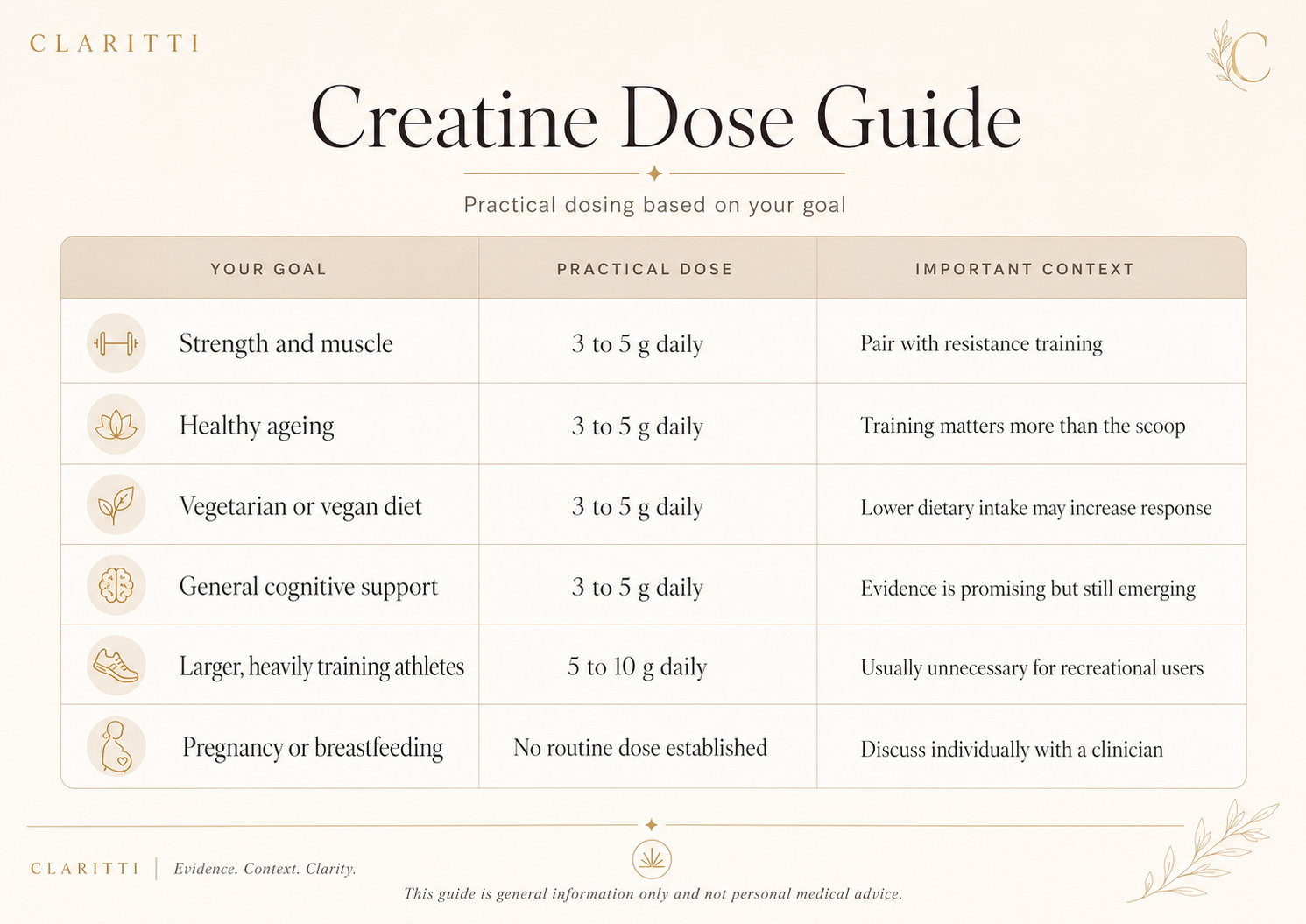
For strength, muscle and training performance
Take 3 to 5 grams daily. This is the most established use of creatine.
It works best alongside resistance training because creatine helps support the training stimulus….. not replace it.
Taking creatine while avoiding resistance training is a little like buying expensive running shoes and waiting for them to improve your cardiovascular fitness from inside the shoebox.
For perimenopause, menopause and healthy ageing
Take 3 to 5 grams daily, ideally alongside regular resistance training. Research involving older women suggests that creatine is most useful when it helps women train, preserve strength and maintain muscle.
A two year randomised trial in postmenopausal women found that 3 grams daily without a structured resistance training program did not improve bone density, lean mass or physical function.
The powder alone is not doing the heavy lifting….. You still have to do some heavy lifting.
For vegetarians, vegans and women who eat little meat
Take 3 to 5 grams daily. Creatine is found mainly in meat and fish, so people eating little or no animal food generally consume less through their diet.
This may mean they have more room to respond to supplementation, particularly for muscle and possibly cognitive outcomes. It does not necessarily mean they need a larger dose, however. The standard daily amount remains a sensible place to begin. The broader research into creatine across the female lifespan is summarised in this review of creatine supplementation in women’s health.
For general cognitive support
There is currently no universally accepted brain specific consumer dose. For a healthy adult interested in the emerging cognition research, 3 to 5 grams daily is the most reasonable evidence aligned starting point.
Some cognition and clinical studies have used higher doses, partly because increasing brain creatine appears to be more difficult than increasing muscle creatine. Leading creatine researchers have gone on the record for personally supplementing up to 20 grams when experiencing high cognitive stress. That does not mean we should all begin casually pouring 20 grams into our morning coffee because we forgot why we entered the kitchen.
Higher doses used in neurological or psychiatric research are research protocols. They are not automatically everyday supplement recommendations, though the clinical evidence is promising.
For larger athletes training heavily
Some larger athletes may require 5 to 10 grams daily to maintain fully elevated muscle stores. For most women exercising recreationally, this will not be necessary.
Start with 3 to 5 grams.
There is no prize for finishing the tub first.
For pregnancy and breastfeeding
There is no established routine consumer dose that I would recommend here. Creatine research in pregnancy is scientifically compelling, particularly around placental energetics and protection from low oxygen stress, but human supplementation data remain limited.
A recent review of creatine in pregnancy and fetal neuroprotection explains why the biology is attracting serious research interest, while also highlighting how much remains uncertain.
During breastfeeding, creatine is naturally present in breast milk, but we still do not have adequate human data measuring how maternal supplementation changes milk creatine or infant exposure. The LactMed database currently recommends caution unless supplementation is prescribed by a healthcare professional.
Pregnancy and breastfeeding therefore remain conversations for your doctor, midwife, obstetrician or dietitian rather than a standard scoop recommendation.
Promising science is not the same as settled clinical advice.
What Should You Ask Your Doctor During Pregnancy?
Pregnancy is not the time for a supplement influencer to become your unofficial obstetrician.
If you are considering creatine, useful questions include:
Is there a clinical reason creatine might be appropriate for me?
Do I have kidney disease or abnormal kidney results?
Could it affect how my blood tests are interpreted?
Is the exact product independently tested?
Would your advice change during breastfeeding?
There may not be a simple yes or no answer. The point is to move the conversation towards your individual health, diet, pregnancy and clinical results.
Do You Need to Load Creatine?
No.
A loading phase increases muscle creatine stores faster, but it is optional. The traditional loading protocol is approximately 20 grams daily, usually divided into four 5 gram doses, for 5 to 7 days. After that, the dose drops to 3 to 5 grams daily.
Another research based method calculates loading as approximately 0.3 grams per kilogram of body weight each day. Loading can saturate muscle stores within about a week, while taking 3 to 5 grams daily without loading will usually achieve a similar level of saturation over approximately 3 to 4 weeks.
Loading is the express train. Daily maintenance is the all stops service.
Both eventually arrive at the same station, but one is more likely to bring bloating and an urgent relationship with your nearest bathroom.
For most women, I would skip loading and take 3 to 5 grams consistently. It is simpler, gentler on the stomach and less likely to produce a rapid change on the scale.
Will Creatine Make You Gain Weight?
It can increase body weight, particularly during loading. Creatine draws water into muscle cells, which can cause an initial increase of around 1 to 3 kilograms in some people, although the amount varies considerably.
This is not body fat.
It is also not necessarily the same as the uncomfortable abdominal bloating caused by gas or digestive upset. The water is primarily being stored inside muscle cells, which is part of how creatine supports cellular hydration and training performance.
Some people enjoy the slightly fuller look this creates in the muscle. Others see the number on the scale rise and assume the powder has personally betrayed them.
Starting with 3 grams daily rather than loading can reduce the likelihood of a noticeable sudden increase.
What Time Should You Take It?
Whenever you will remember it.
Creatine works by gradually increasing tissue stores. It is not a stimulant and does not need to hit your bloodstream at the exact moment you touch a dumbbell.
Taking it after training is perfectly reasonable, but so is taking it with breakfast or dinner. Your muscles are not tiny lawyers checking the timestamp.
Some research suggests that taking creatine close to training or with a meal containing carbohydrate and protein may support uptake. However, the overall evidence suggests that consistency matters far more than precise timing.
Pick a daily habit and attach it to that, whether it is coffee, a smoothie, breakfast or your protein shake.
The best schedule is the one that stops the tub from becoming a kitchen ornament.
Can You Put Creatine in Coffee?
Yes.
Creatine does not instantly collapse when exposed to a warm drink, although the stability question is slightly more nuanced.
Creatine is very stable as a dry powder. Once it is dissolved in liquid, it can slowly convert to creatinine. This conversion happens faster when the drink is more acidic, the temperature is higher and the creatine sits in the liquid for longer.
Stirring creatine into your coffee and drinking it shortly afterwards is therefore very different from mixing it into an acidic drink, leaving it in a hot car all day and returning to it after dinner.
The International Society of Sports Nutrition review reports that degradation in liquid increases as acidity, temperature and storage time increase. For normal daily use, adding creatine to coffee and drinking it reasonably soon is fine.
You can also mix it into water, juice, a protein shake, a smoothie, yoghurt or porridge. You can add it to overnight oats, although adding it closer to eating is preferable to leaving it dissolved for a long period.
It does not need to dissolve completely to be absorbed. A little powder at the bottom of the glass is inconvenient, not biologically catastrophic.
What about caffeine?
Older concerns suggested that caffeine might cancel out creatine’s effects, but the evidence has not established that normal caffeine intake prevents creatine from working.
Some people do experience more stomach discomfort when combining caffeine and creatine, particularly on an empty stomach. If your morning coffee plus creatine creates digestive consequences, take them separately.
Are Creatine Gummies Effective?
They can be, but gummies require much more scrutiny than powder.
A correctly manufactured gummy that provides the stated amount of creatine could theoretically work. Creatine does not become ineffective merely because it has been shaped like a tiny fruit.
The problem is proving that the finished gummy still contains the amount on the label.
In 2025, independent laboratory testing reported by Wired tested six popular creatine gummy products sold online. Four contained little or no detectable creatine, while one product claiming to provide 5 grams per serve reportedly contained approximately 0.005 grams.
At that point, you’re not taking a supplement. You’re just eating a lolly.
The likely issue is formulation. Gummies are often manufactured using heat and acidic ingredients, which can encourage creatine to degrade into creatinine during production or storage.
This does not prove that every creatine gummy is ineffective. It does mean you should demand stronger evidence from a gummy brand than from a simple, single ingredient powder.
For a gummy, check:
Does a full daily serving provide 3 to 5 grams of creatine?
How many gummies are required to reach that dose?
Has the finished product been tested, rather than only the raw creatine ingredient?
Is there a batch specific certificate of analysis?
Can the testing be independently verified?
How much sugar or sugar alcohol are you consuming with the dose?
Some gummies require four, six or even eight pieces to reach the advertised amount. At that point, the convenience is starting to look more like a children’s party table.
Do Capsules Work?
Yes.
Creatine capsules usually contain the same creatine monohydrate found in powder. The main disadvantages are cost and volume, because a meaningful daily dose may require several capsules.
Check the amount of actual creatine per capsule rather than assuming that one or two capsules provide the evidence based dose. Capsules can be useful for travel or for people who strongly dislike powder, but they are generally not the best value.
What Should You Look for in a Quality Creatine?
In general, a good creatine supplement should be rather boring.
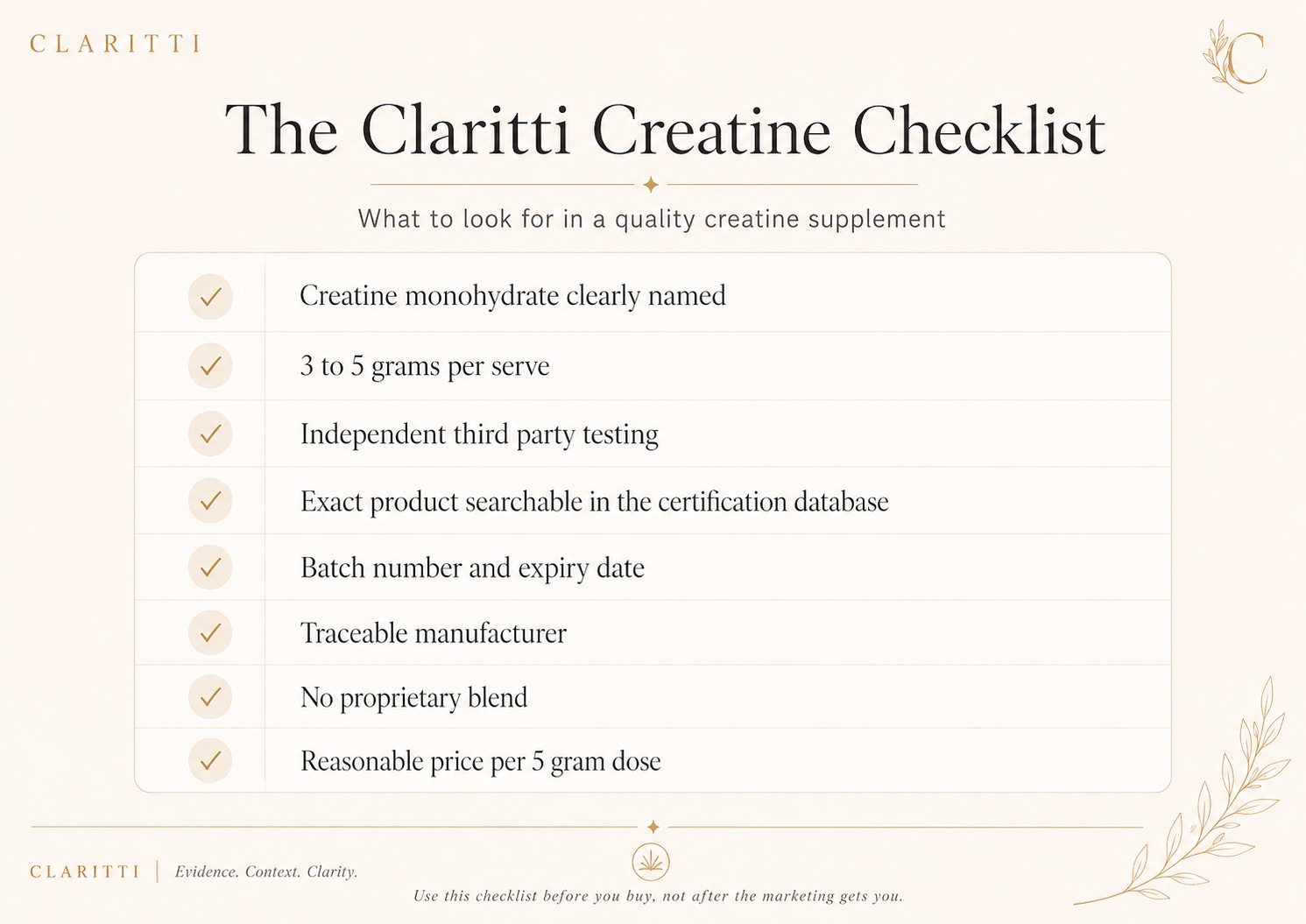
1. Creatine monohydrate should be clearly named
Ideally, it should be the only active ingredient. Flavouring is optional, but extra compounds are usually unnecessary.
2. The dose should be stated in grams
You should be able to see exactly how much creatine monohydrate is in one serving. Be cautious of proprietary blends where creatine is hidden inside a larger mixture.
A label that says “performance matrix 6 grams” does not tell you how much creatine you are receiving. The matrix may contain 5 grams of creatine, or it may contain a decorative teaspoon and a motivational quote.
You cannot tell.
3. The finished product should be independently tested
Third party testing means an organisation separate from the manufacturer has assessed the product. Depending on the certification, testing may cover ingredient identity, dose accuracy, heavy metals, microbial contamination, banned substances and manufacturing quality.
For athletes subject to drug testing, recognised programs include HASTA, Informed Sport and NSF Certified for Sport.
Search the exact product in the certification database rather than assuming that every product made by a certified brand has been tested. The logo should correspond with the exact product, and ideally the exact batch.
4. Look for a batch number
A traceable batch number allows the product to be linked with manufacturing and testing records. A trustworthy company should be able to provide a certificate of analysis that matches the batch on your container.
A generic laboratory report from three years ago for an unnamed white powder is not the same thing.
5. Check where it is manufactured and sold
Look for a traceable company, clear contact information, a sealed package and an expiry date. Buying supplements through an established Australian retailer or directly from a transparent brand provides more accountability than purchasing an anonymous tub through an online marketplace.
A product having thousands of five star reviews does not prove the powder inside matches the label. People also give five star reviews to phone chargers before discovering they catch fire.
6. Calculate the price per useful dose
Ignore the size of the scoop and calculate the price per 3 or 5 gram dose. A larger tub often looks expensive but may cost much less each day.
Powder is usually dramatically cheaper than gummies or capsules.
7. Creapure is reassuring, but not essential
Creapure is a branded, German manufactured form of creatine monohydrate with strict purity standards. It can be a useful quality marker.
However, Creapure has not been shown to produce better strength or muscle outcomes than another genuinely pure, correctly dosed creatine monohydrate. It is a raw material quality badge, not a separate form of creatine.
You can choose it for additional reassurance, but you do not need it for creatine to work.
What Does Creatine Cost in Australia?
Prices change, so these examples were checked on 18 June 2026. They are examples only, not sponsorships or personal endorsements.
BSc Pure Creatine Monohydrate
BSc Pure Creatine Monohydrate was listed as 99.9 per cent pure, micronised and HASTA Certified. The 200 gram tub was listed at $28.
At 3 grams daily, that provides approximately 66 doses and costs around 42 cents per day. At 5 grams daily, it provides 40 doses and costs around 70 cents per day.
The 500 gram tub was listed at $40. At that price, 3 grams daily would cost approximately 24 cents per day, while 5 grams daily would cost approximately 40 cents per day.
Bulk Nutrients Creatine Monohydrate
Bulk Nutrients Creatine Monohydrate was listed across pack sizes from approximately $24 to $48. The exact value depends on the pack selected and whether you are ordering other products at the same time.
What is a reasonable daily cost?
Based on the Australian powder examples checked, plain creatine monohydrate can cost approximately 25 to 70 cents per day before shipping. Larger tubs generally provide better value, while gummies and capsules can cost several times more for the same useful dose.
Creatine itself is inexpensive.
Convenience, flavouring, branding and small pastel packaging are where things begin to get ambitious.
Creatine Red Flags
“Clinically superior creatine”
Ask for the trial directly comparing that form with creatine monohydrate. A study showing that the ingredient is absorbed does not prove it works better. I’d also be asking who had sponsored that particular study.
“No water retention”
Creatine’s movement into muscle is linked with cellular water. A product claiming all the benefits with none of the normal physiology may be selling a misunderstanding as a feature.
“Creatine specifically formulated for women”
Women may have compelling reasons to use creatine, but that does not mean women require a special molecule.
Often the formula is ordinary creatine with flavouring, smaller packaging and what can only be described as the pink tub tax.
“WADA approved”
The World Anti Doping Agency does not approve supplements. Informed Sport explicitly warns that claims such as “WADA approved” are misleading.
A supplement may be independently tested for substances prohibited by WADA, but WADA itself does not certify the product.
Huge claims about fat loss, hormones or mental health
Creatine may support training, muscle preservation and possibly aspects of cognitive health. It is not a direct fat burner, it has not been shown to balance every female hormone, and it is not a replacement for treatment of depression, bipolar disorder or another medical condition.
The more conditions listed on the front label, the more carefully I would read the back.
No dose, no batch and no testing details
If a brand cannot clearly tell you what is in the product, how much is in it and how that claim was verified, keep moving.
Transparency should not require an archaeological expedition through a company website.
What About Kidney Health?
Creatine can increase blood creatinine because creatinine is a breakdown product of creatine. This may affect the interpretation of kidney blood tests.
An increase in creatinine after beginning creatine does not automatically mean the kidneys have been damaged.
A major review addressing common creatine misconceptions concluded that recommended doses have not been shown to damage kidney function in healthy people. However, anyone with existing kidney disease, abnormal kidney results or a condition requiring renal monitoring should discuss supplementation with their clinician.
Tell your healthcare provider that you take creatine before blood testing. This gives them context and may influence which markers they use to assess kidney function.
Pregnancy, breastfeeding, childhood, complex medical conditions and psychiatric treatment also deserve individual clinical guidance.
Do You Need to Cycle Creatine?
No.
There is no established need to take creatine for eight weeks, stop for four weeks, cleanse your energy pathways and wait for Mercury to leave retrograde.
Creatine stores gradually return towards baseline after supplementation stops. For an ongoing goal such as supporting resistance training or preserving muscle, it makes more sense to take an appropriate daily dose consistently.
You can stop whenever you choose, and you do not need to taper it.
The Claritti Verdict
Creatine is one of the rare supplements where doing it right is also doing it cheap: plain monohydrate, certified for purity, 3–5 grams a day, taken consistently, mixed into whatever you’ll actually drink.
Everything else; the exotic forms, the loading drama, the bloating fear, the “women’s formula” with a pink label and a 300% markup, is mostly noise.
Spend your money on purity, not on packaging. Spend your effort on consistency, not on timing. And if pregnancy is in the picture, spend your questions on your doctor, not your shopping cart.
That’s the whole guide. Refreshingly boring. Reliably useful. Which, honestly, is the point.