NAD Part Two: What Actually Happens When You Try to “Boost” It?
Read time: 15 minutes
In the last post, we looked at why NAD has suddenly become one of the loudest molecules in wellness.
Now comes the more important question: what actually happens when you try to increase it?
This is where the story gets interesting, because NAD itself is not the problem. The biology is real. NAD is essential for energy production, DNA repair, inflammation control, mitochondrial function and cellular stress responses.
The issue is what happens when that biology gets turned into a product.
A capsule. A powder. A fertility forum recommendation. A $500 IV drip. A promise that you are about to become “younger at the cellular level.”
That is where we need to slow down.
Because “NAD matters” and “this NAD product will meaningfully improve your health” are related, but far from the same thing.
So let’s look at the evidence properly.
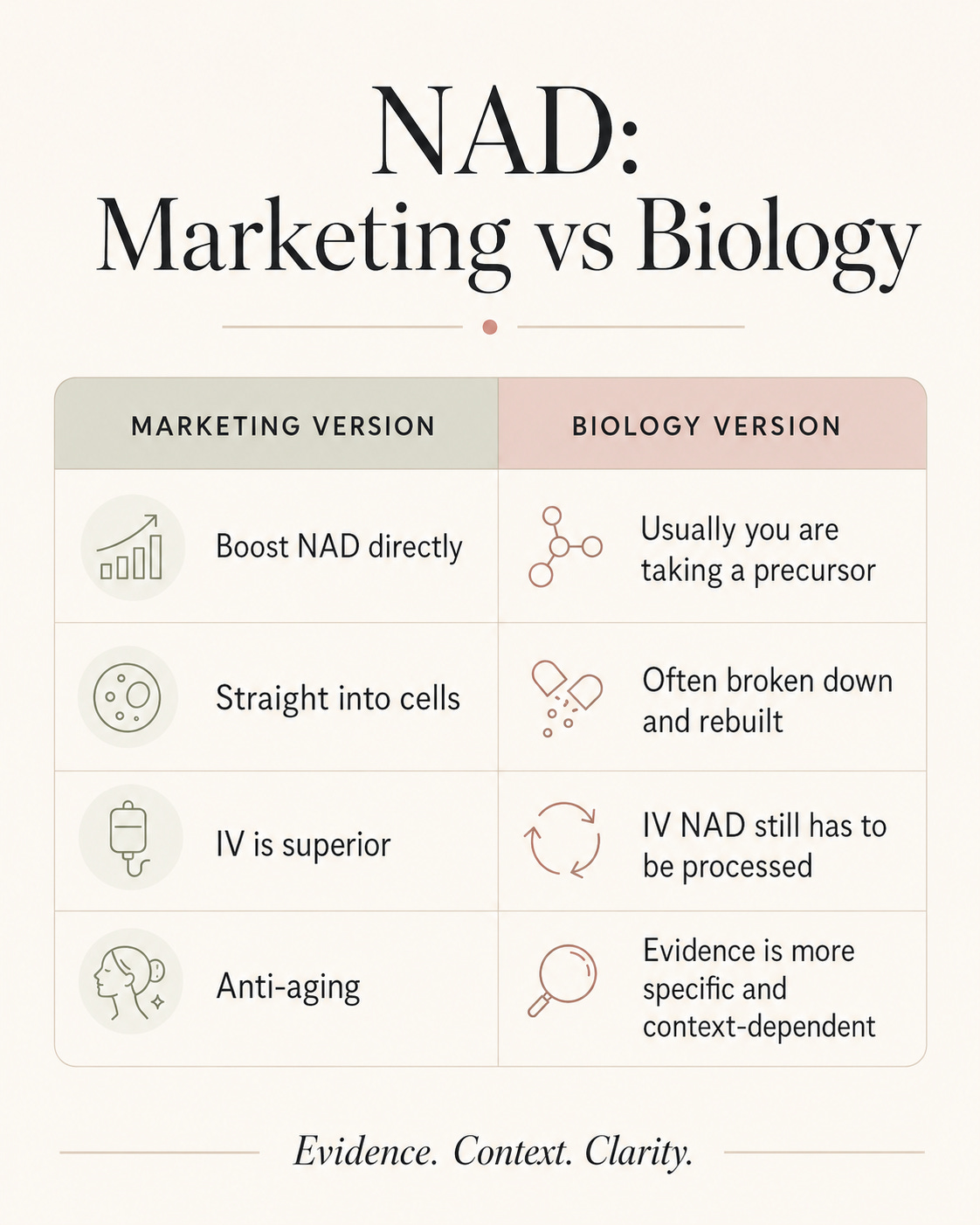
Most people are not actually taking NAD
When people say they are “taking NAD”, they usually mean they are taking something that feeds into the NAD pathway.
That might be NMN, NR, nicotinamide, niacin, or direct NAD+ through an IV clinic. These are different molecules that enter, recycle or support the NAD system in different ways. This matters because a lot of marketing makes NAD sound like one simple tank you can top up.
Low NAD, add NAD, problem solved.
But biology is not a fuel gauge.
NAD is constantly being made, recycled, used and broken down. Your cells do not just need “more NAD” in a vague sense. They need the right balance, in the right tissue, at the right time, with the right metabolic context.
This is one of the biggest gaps between the science and the wellness version of the story. A blood test may show that an NAD precursor increased NAD-related markers in the blood. That is useful, but it does not automatically tell us what happened in your brain, ovaries, skeletal muscle, liver, immune cells or skin.
And it definitely does not prove that you are biologically younger.
The NMN versus NR debate became a marketing war
The two most talked about NAD precursors are NMN and NR.
NMN stands for nicotinamide mononucleotide. NR stands for nicotinamide riboside. If you spend enough time in the longevity corner of the internet, you will eventually hit the argument: which one is better?
NMN fans often say NMN is closer to NAD in the pathway. NR supporters argue NR is better absorbed and more cell-permeable. Both arguments sound convincing when presented on their own.
However, the biochemistry is less tidy.
NR can be converted into NMN inside cells, and NMN can then be converted into NAD. The older argument was that NMN may need to be converted into NR before entering many cells, because NMN carries a phosphate group that makes direct cell entry harder.
Then a proposed NMN transporter called Slc12a8 entered the conversation. Some researchers argued this transporter allowed direct NMN uptake, especially in the intestine. Others challenged how important that pathway really is in humans.
This became more than a technical debate. It became a commercial one.
Some of the biggest names in NAD research are linked to different supplement or therapeutic interests. David Sinclair is strongly associated with NMN. Charles Brenner is strongly associated with NR. So the public conversation has been shaped by evidence, but also by branding, patents, reputations and business incentives.
That does not mean the scientists are wrong. It means consumers need to understand that this debate is not happening in a vacuum.
The gut bacteria plot twist
Here is the part that makes the NMN versus NR fight feel slightly less dramatic.
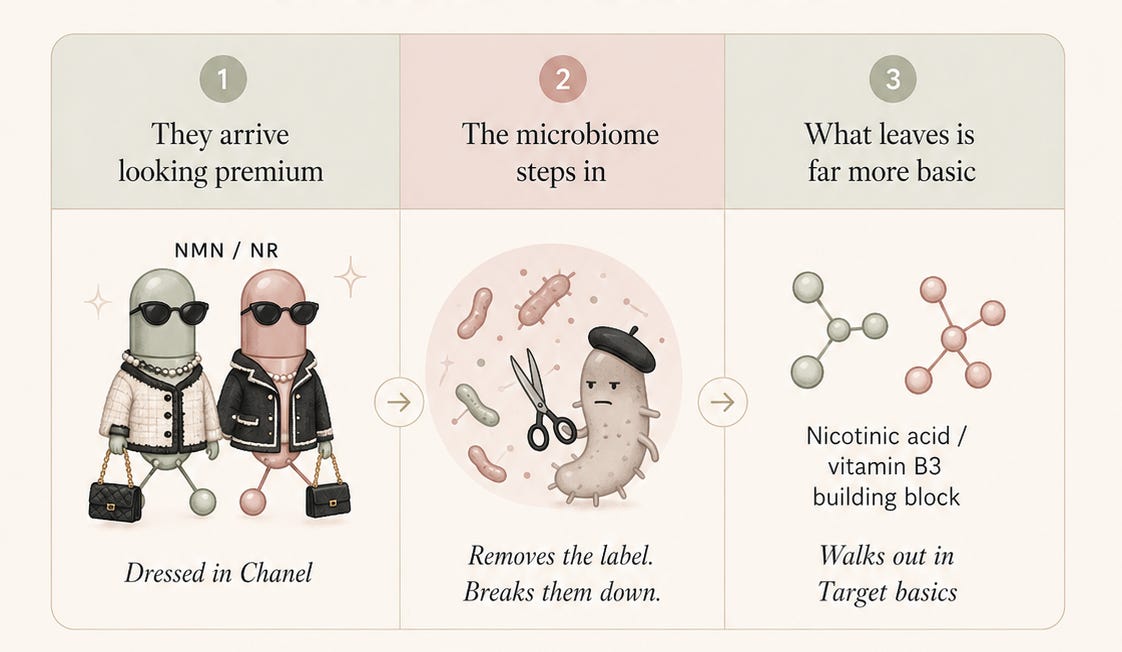
Recent human research suggests that when NMN and NR are taken orally, they may not be absorbed intact in the direct, elegant way many supplement ads imply. Instead, gut bacteria appear to play a major role.
In a head-to-head human trial published in Nature Metabolism, 65 healthy adults took NR, NMN, nicotinamide or placebo for 14 days. Both NR and NMN increased whole-blood NAD+ levels, but the pathway looked less like direct delivery and more like microbial processing. The data suggested that gut bacteria helped convert these precursors toward nicotinic acid, a form of vitamin B3 that can then feed into NAD production. (PubMed Central)
Basically, the NMN and NR arrive in the gut dressed in Chanel. The microbiome takes one look, removes the label, and sends them out in Target basics. Rude, but biochemically useful.
This matters because if the gut microbiome is doing a lot of the heavy lifting here, the argument that one expensive precursor has a uniquely superior direct route into your cells becomes less convincing.
NMN and NR may still be useful. The point is that the body seems to be using them in a less glamorous way than the marketing suggests.
More gut chemistry. Less cellular teleportation.
It also makes the whole “sublingual” and “liposomal” trend more complicated. Many of those products are marketed as superior because they claim to bypass the gut. But if the gut microbiome is one of the key reasons oral precursors raise NAD in the first place, bypassing the gut may not be the advantage people think it is.
That does not make every sublingual product pointless. It means the claim needs actual clinical proof, not just clever packaging.
IV NAD sounds powerful, but the biology is awkward
IV NAD has become one of the most glamorous parts of the NAD industry. It sounds medical, feels premium, and costs enough to feel important. The marketing is usually very polished: bypass the gut, flood your cells, restore energy, reboot your biology.
The biology is less convenient.
Placing NAD+ directly into a vein does not mean it simply enters cells intact.
Quick note on the “+”: NAD+ is the oxidised form of NAD. It does not mean “extra powerful wellness version”. It means the molecule is ready to pick up electrons and help move energy through the cell.
A human pilot study tracked plasma and urine NAD metabolites during a six-hour IV NAD+ infusion. The study found that directly infused NAD+ was rapidly processed, with downstream metabolite changes appearing during and after the infusion. So the body was not receiving NAD and sending it straight into cells like an express courier. It was breaking it down and processing it. (PubMed)
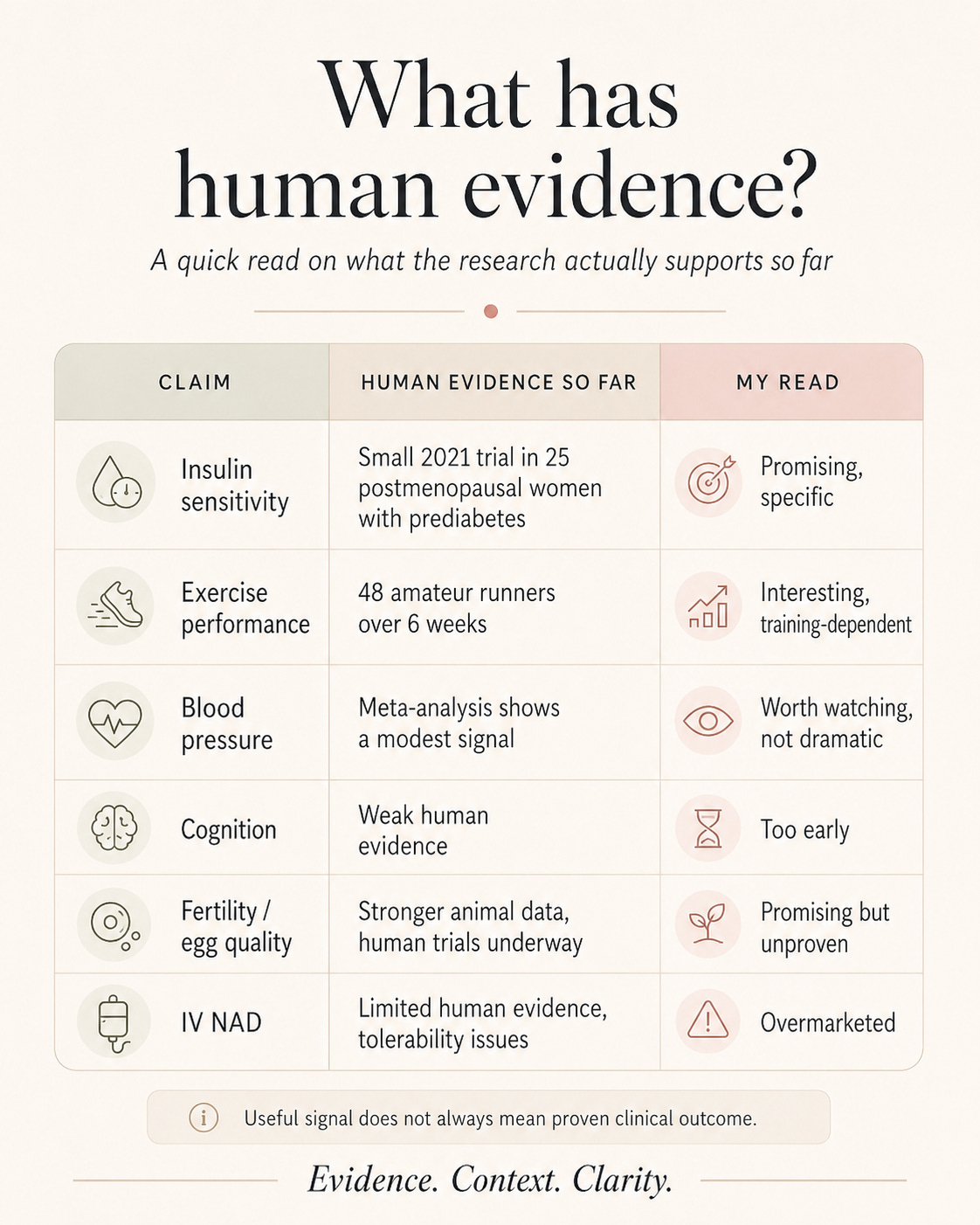
There is also the tolerability issue. Direct IV NAD can be uncomfortable, especially when infused too quickly. People can experience chest pressure, nausea, abdominal cramping, flushing, muscle cramps or a racing-heart sensation. That is why NAD drips often need to run slowly.
This does not mean every person who has an NAD drip is harmed, or that nobody feels better afterwards. It means the premium image is ahead of the data.
Oral precursors currently have more human trial evidence than direct IV NAD. The idea that IV NAD is automatically the more serious, more effective option is not well supported.
Sometimes the most expensive version is just the most expensive version.
What benefits have actually been shown in humans?
This is where we need to separate “interesting” from “proven”.
NAD precursors can raise NAD-related markers in humans. The harder question is whether that leads to meaningful health outcomes. The answer depends heavily on who is taking it, what dose they are taking, how long they take it for, and what outcome is being measured.
The strongest signals so far seem to be in specific groups, rather than healthy people taking NAD boosters as a vague anti-aging strategy.
One of the more compelling human studies was published in Science in 2021. It looked at 25 postmenopausal women who were overweight or obese and had pre-diabetes. They took 250 mg of NMN daily for 10 weeks. The main finding was improved skeletal muscle insulin sensitivity and insulin signalling. (PubMed)
That matters because skeletal muscle is one of the major places the body clears glucose from the bloodstream. Improving insulin sensitivity there is clinically meaningful. However, the study was small, and the group was specific.
So the clean takeaway is this: NMN may improve aspects of skeletal muscle insulin sensitivity in postmenopausal women with metabolic dysfunction.
That is more useful than turning it into a generic anti-aging claim. A result in postmenopausal women with pre-diabetes cannot automatically be applied to a healthy 32-year-old taking NMN because a podcast said it slows aging.
The exercise data is interesting
Another human trial looked at NMN in 48 recreationally trained middle-aged runners over six weeks. Participants took different doses of NMN while continuing exercise training. The higher-dose groups showed improvements in oxygen uptake and ventilatory threshold measures, with the researchers describing the effect as dose-dependent and muscle-related. (PubMed)
That is still interesting, especially if you are thinking about endurance, mitochondrial function and how muscles use oxygen during training. But the training context matters. The supplement may have supported adaptation, but the exercise was still doing the heavy lifting.
Blood pressure: a modest signal
The blood pressure evidence is measured. A 2026 meta-analysis of 10 randomised controlled trials, including 349 adults, found a statistically significant but modest reduction in diastolic blood pressure with NMN supplementation. Systolic blood pressure effects appeared more relevant in adults aged 60 and older. (PubMed)
That makes biological sense. If NAD depletion is more relevant in older, metabolically stressed or vascularly stiffened systems, the benefit may show up most clearly in people who already have pressure on that system.
The blood pressure story is modest, but still worth paying attention to. Modest signals are still useful when we describe them honestly.
Cognition: the human evidence is still weak
The brain is one of the areas where NAD marketing can get very confident very quickly.
The animal studies are interesting, but human evidence is not strong enough yet to say that NAD boosters meaningfully improve cognition in healthy adults. Small trials have shown that NAD-related markers can rise. That does not automatically translate into better memory, reduced dementia risk or slower cognitive decline.
This can obviously change with more research, but for right now, if a product is promising brain protection based on NAD, the claim is running ahead of the human data.
The women’s health angle is promising, but easy to overstate
This is the part I find the most interesting and frustrating.
Interesting because NAD biology genuinely intersects with ovarian aging, mitochondrial function and egg quality. Frustrating because those early findings can be turned into very bold claims very quickly.
Egg cells are incredibly energy-dependent. They rely on mitochondrial function to mature, divide properly and maintain chromosomal stability. As ovaries age, mitochondrial function declines, oxidative stress increases and egg quality drops.
In animal studies and preclinical research, NMN has shown promising effects on oocyte and ovarian function under age-related, metabolic and stress-related conditions. A 2025 systematic review concluded that NMN consistently improved oocyte and ovarian function across seven preclinical studies, but that evidence remains preclinical. (PubMed Central)
That is genuinely exciting.
But animal ovarian rescue is not the same as proven human fertility treatment. At this stage, there is no strong published human evidence showing that NMN or NR improves live-birth rates, reverses menopause, restores fertility or extends the reproductive window in women.
There are human trials underway, including NCT06629636, which is investigating whether NMN supplementation can improve embryo developmental capacity and IVF outcomes in women with previous IVF failure. That is worth watching, but it is still early. (ClinicalTrials)
This distinction matters because fertility is an emotionally vulnerable space. Women navigating IVF, declining ovarian reserve, recurrent disappointment or age-related fertility pressure are often willing to try anything that feels biologically plausible.
I understand that completely.
But plausibility is not the same as evidence.
The fair position is that NAD and ovarian aging is one of the most interesting areas of the field. The animal data is strong enough to justify human trials. It is not strong enough to sell women certainty.
Not yet.
What about menopause?
The menopause claims sit in a similar category.
There is early interest in whether NAD precursors could support some symptoms or metabolic changes during the menopause transition. That makes sense biologically. Menopause is associated with changes in sleep, energy, body composition, insulin sensitivity, vascular function and inflammation. NAD biology overlaps with several of those systems.
But menopause is a major endocrine transition driven by ovarian follicle depletion and changing estrogen signalling. So when a product implies that boosting NAD will “fix” menopause, that should raise your eyebrows.
There is some early pilot data suggesting symptom improvements with combinations such as NR plus pterostilbene, including changes in hot flashes, bloating and sleep. Small studies, open-label designs and self-reported symptoms can be useful starting points, but they are not enough to justify sweeping claims.
The honest answer is: interesting, plausible, not settled.
The cancer warning is where I would be most cautious
NAD supports DNA repair and cellular resilience. In healthy cells, that can be protective.
The uncomfortable part is that cancer cells also use NAD aggressively. They divide rapidly, repair damage, and adapt under stress. They have high metabolic demands. If you provide more of the resources that help cells survive, there is a legitimate concern that established cancer cells could benefit too.
This does not mean NAD supplements cause cancer in healthy people. The concern is more specific.
A 2026 study in Cancer Letters reported that vitamin B3 derivatives, particularly NMN, supported pancreatic cancer cell survival and chemotherapy resistance in laboratory models. NMN showed the strongest protective effect on cancer cells and increased resistance to oxaliplatin, 5-fluorouracil and gemcitabine in vitro. (PubMed)
So this is one area where I would not be casual.
If someone has active cancer, a recent cancer diagnosis, is undergoing chemotherapy, or is under oncology care, NAD boosters should not be a DIY wellness experiment. That conversation belongs with an oncologist.
Are NAD boosters safe?
Short-term human studies of oral NMN and NR are generally reassuring. They appear well tolerated in the doses commonly studied, with side effects usually mild and temporary.
A randomised placebo-controlled trial found that NMN increased blood NAD concentrations and was safe and well tolerated at oral doses up to 900 mg/day. For NR, the NR-SAFE trial reported that 3000 mg/day for four weeks was well tolerated without moderate or severe adverse events, although the authors noted that longer-term safety at that dose still needs to be established. (PubMed)
Things like nausea, bloating, diarrhoea, headaches or muscle cramping can happen, but serious adverse events have not been a major signal in short-term trials.
There are two important caveats.
First, short-term safety does not tell us what happens with years of daily use. Most human trials are small and short. Many run for weeks, not years.
Second, not all NAD-related compounds are the same. High-dose nicotinamide, for example, has a different risk profile from NMN or NR. At high doses, nicotinamide can place pressure on methylation pathways and has been linked with metabolic and liver-related concerns.
So “vitamin B3” is not one thing.
Dose matters. Form matters. Context matters.
The big problem with the current evidence
The main issue with NAD research is not that there is no evidence. There is evidence.
The problem is that the evidence is patchy.
Many trials are small. Many are short. Different studies use different doses, different populations, different formulations and different ways of measuring NAD.
Some measure whole blood. Some measure plasma. Some look at peripheral blood cells. None of those perfectly tell us what is happening in the tissue we might actually care about.
If someone is taking NAD precursors for brain health, we want to know what is happening in the brain. If someone is taking them for fertility, we want to know what is happening in the ovary and, more importantly, whether clinical outcomes improve. If someone is taking them for metabolic health, we want to know whether insulin sensitivity, body composition, liver fat, vascular function or long-term disease risk actually changes.
Raising a biomarker is useful. But biomarkers are not the finish line. Clinical outcomes are.
So where does this leave us?
NAD is not a scam. The biology is real. The science is genuinely interesting. NAD precursors may turn out to be useful in specific clinical settings, especially where aging, metabolic stress, inflammation or mitochondrial dysfunction are involved.
The current wellness narrative is running ahead of the evidence.
The strongest version of the argument is that NAD metabolism is an important cellular system that becomes vulnerable under age-related and metabolic stress, and early human trials suggest that supporting this system may have targeted benefits in specific groups.
Less catchy. More accurate. Probably more useful.
For now, the people most likely to benefit are not necessarily healthy twenty or thirty somethings trying to optimise already normal biology. The more plausible benefit seems to be in people with measurable stress on the system: older adults, postmenopausal women with metabolic dysfunction, people with insulin resistance, or possibly specific fertility cohorts being studied in clinical trials.
That does not mean healthy people cannot take them. It means the promise is less certain.
If someone is taking an NAD precursor, I would be more interested in the basics than the branding. Is the product third-party tested? Is the dose similar to doses used in human trials? Is the person taking it for a specific reason, or just because the internet said “anti-aging”? Are they pregnant, breastfeeding, undergoing fertility treatment, managing a chronic disease, or receiving cancer care?
And are they also doing the boring things that naturally support mitochondrial and metabolic health: exercise, sleep, adequate protein, alcohol moderation and managing inflammation?
Because no supplement can outsmart the context it lands in.
The Bottom Line
NAD is one of those topics where both extremes are wrong.
The hype is too confident. The dismissal is too lazy.
This is not just wellness nonsense, and it is not a proven youth molecule either. The most honest position sits somewhere in the middle.
NAD matters. Boosting NAD can change measurable biology. Whether that change translates into better health depends on the person, the tissue, the dose, the formulation, the microbiome, the disease state and the outcome being measured.
That is not as satisfying as a before-and-after biological age test.
But in a space this noisy, the truth is probably the most useful thing we have.
Next up
We’ll move from the evidence to the routine.
What does supporting NAD actually look like in real life? Exercise, sleep, alcohol, nutrition, supplements, IV clinics, cost, what to expect, and what deserves caution.
Because the real question is not just whether NAD matters.
It is what is actually worth your time, money and energy.