Read time: 14 minutes
Red light therapy has entered its expensive era. It is in face masks, recovery beds, hair helmets, wellness clinics, biohacking podcasts, sleep routines and celebrity bathrooms. It promises better skin, faster healing, thicker hair, less pain, more energy, better sleep, improved mitochondria and, depending on how generous the marketing department is feeling, a longer life.
That is a lot of glow for one wavelength of light.
The difficult part is that red light therapy is not nonsense. There is real substance here. There are legitimate medical uses. There are human trials showing benefit in some areas. There is also a fast-growing consumer market that has stretched the science into something shinier than the evidence can always support.
So the question is not, “Does red light therapy work?” The better question is: What does it work for, how strong is the evidence, and where has wellness marketing sprinted ahead of the data?
Let’s get into it.
What actually is red light therapy?
Red light therapy sits under the broader term photobiomodulation, often shortened to PBM. Already it sounds complicated, but the idea is fairly simple. Certain wavelengths of light appear to interact with cells in a way that can influence energy production, inflammation, blood flow and tissue repair.
Most devices use red light, near-infrared light, or a combination of both. Red light usually sits around 620 to 700 nanometres. Near-infrared light usually sits around 700 to 1000 nanometres, although definitions vary slightly depending on the source. Red light tends to act more superficially, which is why it is often used for skin. Near-infrared light penetrates deeper, which is why it is often marketed for muscles, joints and recovery.
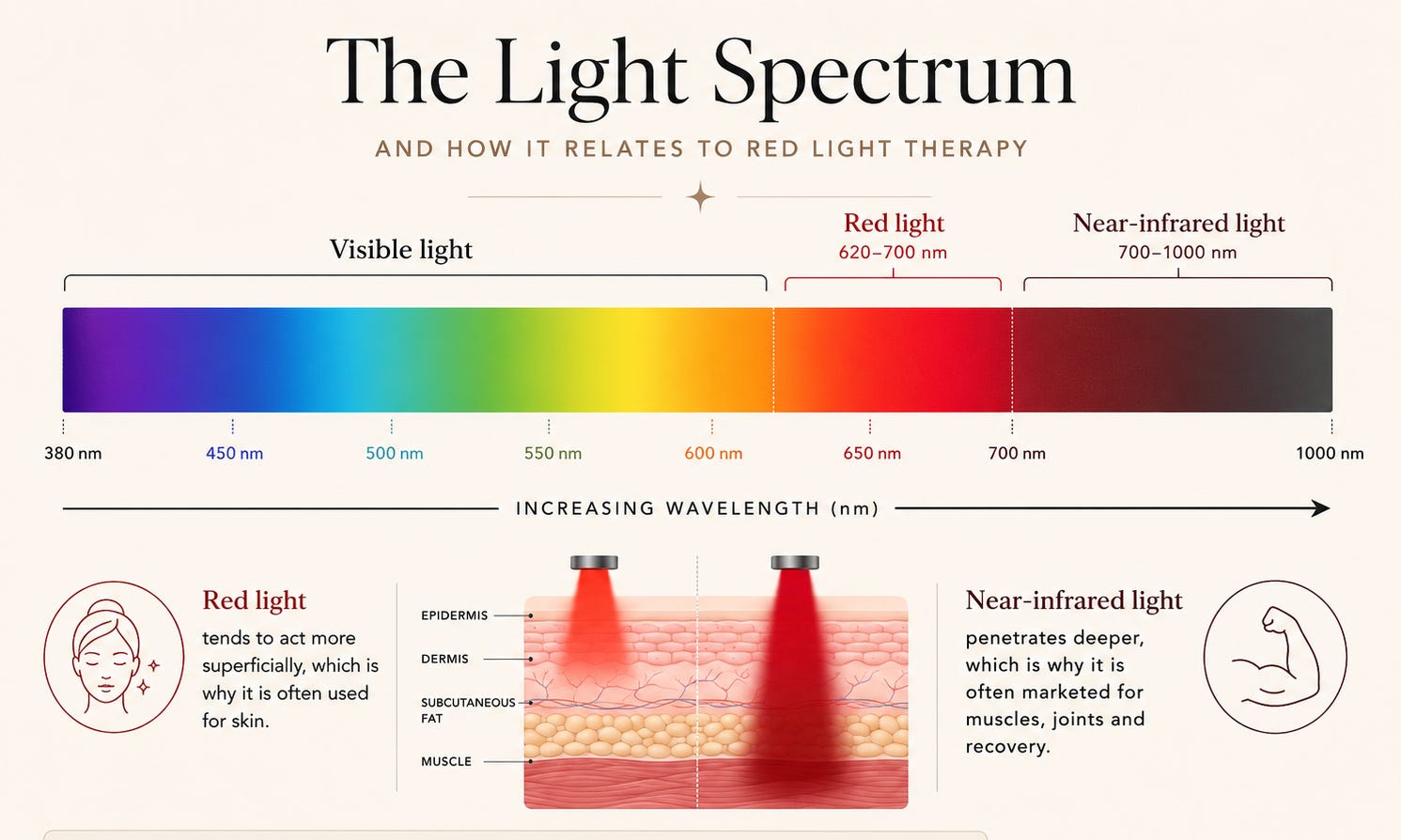
That does not mean deeper is always better.
It means the details matter. The wavelength matters. The dose matters. The intensity matters. The treatment time matters. The distance from the skin matters. The number of sessions matters. The tissue being treated matters. And, unfortunately, most wellness marketing does not love details. It prefers a before-and-after photo and the word “mitochondria” in a very confident font.
The mitochondrial story
Most red light therapy explanations start with the mitochondria. Mitochondria are the energy-producing structures inside cells. They help convert food and oxygen into ATP, which is the energy currency cells use to function.
One of the main proposed mechanisms of red light therapy involves an enzyme in the mitochondrial respiratory chain called cytochrome c oxidase. In english, certain wavelengths of red and near-infrared light may be absorbed by this enzyme, helping improve mitochondrial activity, cellular energy production and signalling pathways involved in repair and inflammation.
This mechanism is described in several photobiomodulation reviews, including work on the cellular mechanisms of low-level light therapy and broader reviews of photobiomodulation, cytochrome c oxidase, nitric oxide and ATP production.
Another piece of the mechanism involves nitric oxide. Nitric oxide can bind to cytochrome c oxidase and slow mitochondrial respiration. Red and near-infrared light may help displace nitric oxide, potentially improving oxygen use and ATP production. Nitric oxide is also involved in blood vessel relaxation, which may partly explain why PBM is studied in wound healing, tissue repair and circulation-related conditions.
This is where the longevity conversation begins. If mitochondrial dysfunction is linked with ageing, and red light can influence mitochondrial activity, then surely red light therapy is a longevity tool?
Maybe….
A therapy can influence biological pathways associated with ageing without proving that it meaningfully extends human healthspan or lifespan. Those are different claims.
Red light therapy may support processes involved in tissue repair, inflammation and cellular energy. That is interesting. It is not the same as proving that standing in front of a glowing panel will make you live longer.
The dose problem
One of the most important parts of red light therapy is also one of the least talked about: The dose response is biphasic. This means more is not always better.
Too little light may do nothing. A moderate dose may trigger a useful cellular response. Too much may be less effective, or potentially counterproductive. This is often described as a hormetic effect: a small controlled stress that may stimulate adaptation. But like exercise, the right dose matters. A walk and an ultramarathon are both movement. They do not do the same thing to the body.
This matters because consumer devices vary enormously. Some have strong irradiance. Some are weak. Some deliver uneven light. Some are used too close. Some are used too far away. Some people use them daily for long periods because they assume more glow equals more benefit.
That assumption is not how photobiomodulation works.
So what does the evidence actually support?
Here is the Claritti version.
The strongest evidence is not for “longevity.” It is for specific clinical uses, especially tissue healing, oral mucositis, some pain conditions, skin ageing and hair loss. The evidence is more mixed for sports recovery, sleep, cognition and metabolic health. The weakest evidence is for broad wellness claims like “detox,” “anti-ageing,” “immune reset,” “fat loss,” “hormone balancing” or “living longer.”
That does not mean all of those ideas are impossible. It means they are not proven in the way they are often sold.
Skin rejuvenation: probably the most believable consumer claim
If there is one red light claim that feels the most realistic for home users, it is skin. Skin is accessible. Red light reaches it easily. The biology is plausible. And there are human studies showing improvements in wrinkles, collagen, skin texture and firmness.
A 2023 randomised split-face trial looked at women aged 40 to 65 and tested red and amber light around the eye wrinkles. The study found around a 30% reduction in wrinkle volume after treatment, although it did not show meaningful improvements in every skin measure, such as hydration or elasticity.
That is a good example of what the evidence actually looks like.
Promising? Yes. A facelift in a red light mask? No.
Other studies and reviews have also reported improvements in skin texture, fine lines, collagen density and photodamage after red or near-infrared LED therapy, including research looking at LED phototherapy for skin rejuvenation and red light therapy for facial ageing.
The likely mechanism is that red light may stimulate fibroblasts, the cells involved in making collagen and elastin. It may also reduce inflammatory signalling and influence enzymes that break down collagen. This is why red light therapy is so often marketed for fine lines, firmness, texture and “glow.”
But the results are usually gradual and modest. You are not likely to wake up looking like your passport photo from 2009. The more realistic expectation is subtle improvement in skin quality over time, especially when used consistently and alongside the boring things that still do most of the heavy lifting: sunscreen, sleep, nutrition, not smoking, and evidence-based skin care.
This is the part the wellness industry does not love.
A red light mask may help. But it does not replace sunscreen.
The pigmentation question
This is where the story gets more complicated, especially for women prone to melasma or post-inflammatory hyperpigmentation. Some controlled studies suggest that certain light protocols may improve pigmentation conditions by reducing inflammation, vascular activity or melanin production. But that does not mean every red light panel is automatically safe for every skin type.
Melasma is not just “extra pigment.” It is a complex condition involving melanocytes, inflammation, vascular changes, hormones, UV exposure and heat sensitivity. This is why pregnancy, oral contraceptives, sun exposure and heat can all make it worse.
That matters because red light and near-infrared devices are not all the same. Some produce heat. Some deliver uneven energy. Some are used too aggressively. Some are not well calibrated. For people with darker skin types, melasma or a history of pigmentation after inflammation, this is not a reason to panic. It is a reason to be cautious.
If pigmentation is the concern, a dermatologist-led plan is very different from buying the strongest panel on the internet and hoping for the best.
Wound healing: where red light gets more medically interesting
The stronger medical story for PBM is tissue repair. Red and near-infrared light have been studied in wound healing for years. The proposed benefits include improved mitochondrial activity, better microcirculation, reduced inflammation, collagen remodelling and faster tissue repair.
This does not mean red light therapy magically heals every wound. But in clinical settings, particularly when the dose and protocol are controlled, PBM has shown promise as an add on treatment.
There is research looking at PBM for diabetic foot ulcers and wound healing more broadly, including reviews on low-level light therapy and tissue repair.
The key word is adjunct.
If someone has a chronic wound, infection, surgical wound complication or delayed healing, in clinical settings, red light therapy has shown promise as an add-on treatment for wound healing, particularly when the dose and protocol are controlled. Therefore, it may be part of a treatment plan, but it is not the treatment plan alone.
Oral mucositis: one of the most legitimate uses
One of the strongest and most clinically accepted uses of photobiomodulation is in supportive cancer care, particularly oral mucositis. Oral mucositis is a painful inflammation and ulceration of the mouth that can occur during chemotherapy or radiotherapy. It can make eating, drinking and speaking extremely difficult, and in severe cases it can interrupt cancer treatment.
PBM has been included in clinical practice guidelines for oral mucositis, which is important because it shows this is not just a wellness trend. In some settings, it is a legitimate supportive therapy.
But this is also where nuance matters. Using PBM to reduce treatment-related side effects under clinical guidance is not the same as using red light to treat cancer. It is not a cancer cure.
A systematic review on the oncologic safety of low-level light therapy for aesthetic skin rejuvenation found no clear evidence that properly delivered red or near-infrared light for skin rejuvenation increases cancer risk. That is reassuring, especially for cosmetic use. But it does not mean everyone should use any device anywhere on the body without context.
Cancer history, active malignancy and treatment sites are situations where medical advice matters.
Hair growth: not magic, but not ridiculous either
Red light therapy for hair loss sounds gimmicky until you realise this is one of the areas with a reasonable amount of human data. Low-level laser therapy and LED devices have been studied for androgenetic alopecia, also known as pattern hair loss. This includes combs, caps and helmets that use red or near-infrared light.
A 2021 systematic review and meta-analysis of FDA-cleared home-use low-level light devices reported improvements in hair density in pattern hair loss. A 2022 systematic review and meta-analysis also found that PBM may improve hair growth outcomes, though device type, wavelength, treatment schedule and study quality all matter.
The likely mechanism involves improved cellular energy in hair follicles, reduced inflammation and effects on the hair growth cycle. But the consumer translation needs caution. Hair loss is not one condition. It can be driven by genetics, hormones, thyroid disease, iron deficiency, autoimmune conditions, stress, postpartum changes, medications and nutritional factors.
A red light helmet may help some people with pattern hair loss. It will not fix low ferritin, thyroid disease or postpartum shedding that needs time and context. It also requires consistency. Hair grows slowly. Any genuine improvement is likely to take months, not days.
So this one sits in the “plausible and evidence-supported, but not miraculous” category.
Pain, inflammation and recovery: promising, but messy
This is where red light therapy gets interesting and also frustrating. PBM has been studied for pain, osteoarthritis, tendinopathy, temporomandibular disorders, fibromyalgia, muscle soreness and sports recovery. Some studies show benefit. Some do not. A major reason is that protocols vary dramatically.
Different wavelengths. Different doses. Different body areas. Different timing. Different devices. Different outcomes.
An umbrella review of PBM across musculoskeletal and pain conditions found that evidence varied by condition, with some moderate-certainty findings and many low-certainty or inconsistent areas. In plain English: there is probably something here, but it is not one clean story.
For exercise recovery, reviews have explored whether PBM can reduce delayed onset muscle soreness, muscle damage markers and fatigue, including research on photobiomodulation and exercise performance or recovery. Some results are encouraging, especially when light is applied before or after exercise using controlled protocols. But again, this is not the same as saying any red light panel will make you recover like an Olympic athlete.
For the average person, red light therapy may be a useful add on for pain or recovery. But it should sit behind the basics: progressive loading, sleep, protein, iron status, stress management, injury diagnosis and appropriate rehab. Wellness tools often become appealing because they feel easier than the boring foundations.
The foundations still matter.
Cognition and brain ageing: interesting, early, not proven
Near-infrared light can penetrate more deeply than red light, which has led to interest in transcranial photobiomodulation. This means applying near-infrared light to the head with the aim of influencing brain tissue, blood flow, mitochondrial activity or neuroinflammation.
This area is interesting. It is also early.
There are small studies looking at mood, cognition, traumatic brain injury and neurodegenerative conditions. Some animal and early human research suggests possible effects on brain metabolism, inflammation and cognitive performance, including work exploring transcranial photobiomodulation and cognition and photobiomodulation in Alzheimer’s disease.
But this is not yet a proven dementia-prevention strategy. The leap from “near-infrared light may influence brain-related pathways” to “this device prevents cognitive decline” is too large. The idea is worth studying.
Sleep and circadian rhythm: possible, but not the main event
Red light is often promoted as a sleep tool. This claim partly comes from the fact that red light is less disruptive to melatonin than blue-rich light. That is true in a broad circadian sense. Warm, dim light at night is generally less disruptive than bright blue-white light.
But that is not the same as saying red light therapy itself is a powerful sleep treatment. Some studies have looked at red light exposure and sleep, including research in athletes and smaller human trials. The findings are interesting but not strong enough to treat red light as a primary sleep intervention.
For most people, the biggest wins are still obvious and positively boring: morning outdoor light, consistent wake time, dim evenings, less bright light at night, caffeine timing, alcohol reduction, temperature, and managing stress. Red light may be a nice addition. It is not a replacement for circadian basics.
Metabolism, glucose and weight loss: the marketing is ahead
Red light therapy is increasingly being marketed for metabolism, fat loss and glucose control. This is where I would be more sceptical.
There are early studies looking at red light and blood glucose, including a small study exploring whether red light exposure affected blood glucose after an oral glucose challenge. Mechanistically, it is not absurd. Mitochondria are central to metabolism. Blood flow and cellular signalling matter.
But we are a long way from saying red light therapy treats insulin resistance, causes meaningful fat loss or replaces nutrition, muscle mass and movement. If a device is being sold as “effortless fat loss” or “metabolic reset,” that is where the alarm bells should start ringing.
The biology isn’t impossible, the claim is just bigger than the evidence.
The longevity claim
Now to the big one.
Does red light therapy help you live longer?
In humans, we do not know.
There are preclinical studies looking at mitochondrial function, inflammation, cellular senescence, oxidative stress and age-related decline. There are animal studies suggesting that PBM may influence ageing-related pathways. There are plausible mechanisms. But we do not have strong human evidence showing that red light therapy extends lifespan or meaningfully improves long-term healthspan.
This is the difference between longevity biology and longevity marketing. Longevity biology asks: does this intervention influence pathways related to ageing? Longevity marketing asks: can we put “anti-ageing” on the box?
Those are not the same question.
A fair summary would be this: red light therapy may support certain biological processes involved in repair, inflammation and mitochondrial function. It can improve some specific outcomes, especially in skin, wound healing, oral mucositis, hair loss and some pain conditions. But it has not been proven to make humans live longer.
That sentence is not as exciting as “turn on this panel and reverse ageing.” However, it is much more accurate.
The device problem
One of the biggest issues with red light therapy is that the device market has moved faster than the evidence. A clinic-grade device used in a study is not the same as a cheap mask from the internet. A laser is not the same as an LED. A targeted treatment is not the same as standing in front of a whole-body panel. A red glow is not automatically a therapeutic dose.
When looking at a device, the important details are: what wavelength does it use, what is the irradiance, what dose reaches the skin, how far away should you sit or stand, how long is each treatment, how many sessions per week, and has that specific device been clinically tested?
One important clarification: FDA-cleared does not always mean clinically proven for every claim being advertised. It often means the device has met a regulatory pathway for safety and substantial equivalence. That is useful. Although, is not the same as saying the exact device has strong human evidence for collagen, sleep, pain, fat loss and longevity.
This is why “medical grade” can be a slippery slope. Sometimes it means something. Sometimes it is just marketing wearing a lab coat.
Safety: mostly reassuring, but not context-free
Red light therapy is generally considered low risk when used appropriately. It is non-ionising, meaning it does not damage DNA in the way ultraviolet radiation can. It is usually non-thermal, although some devices can produce heat.
But low risk does not mean no risk.
The main safety considerations are eye exposure, photosensitising medications, photosensitive medical conditions, active cancer sites, infected wounds, undiagnosed lesions, melasma, pregnancy and overuse. Context matters.
Use eye protection, especially with strong panels or near-infrared devices. Be cautious if you are taking photosensitising medications or have a photosensitive medical condition. Avoid using red light over active cancer sites unless your treating team specifically advises it. Do not use aggressive devices over infected wounds or undiagnosed lesions instead of seeking care. Be cautious with melasma or pigmentation-prone skin. Avoid using red light directly over the pregnant abdomen, not because there is clear evidence of harm, but because there is not enough safety data to justify it casually.
And do not assume longer sessions are better.
A systematic review on oncologic safety was broadly reassuring for aesthetic skin use within established parameters. That is reassuring, but it does not mean the same advice applies to every person, every device or every situation.
The safest version of red light therapy is targeted, moderate, consistent and realistic. The riskiest version is usually overuse, overclaiming or using it to delay proper medical care.
What I would believe
Red light therapy can modestly improve skin texture, fine lines and collagen-related markers when used consistently with an appropriate device. PBM has legitimate clinical uses in wound healing and oral mucositis when delivered with proper protocols. Low-level light devices may help some people with pattern hair loss, especially when used consistently for months.
I would also believe that red light therapy may help some pain or recovery outcomes, although the evidence is mixed and protocol-dependent. It also appears to have interesting effects on mitochondria, inflammation and cellular signalling.
What I would side-eye
Any claim that red light therapy “reverses ageing,” effortless fat loss claims or “detox” claims. Or any use of the word “mitochondria” without talking about dose.
A device that cannot clearly state wavelength, irradiance, treatment distance and treatment time is also out for me. I’m always keen for the before-and-after photos, however, with no lighting control, no timeline, no skin care context and no disclosure of other treatments this is also an eye roll.
And I would definitely side-eye using red light therapy instead of getting a wound, lesion, pain condition or hormonal issue properly assessed.
The Claritti takeaway
Red light therapy is a good example of how wellness trends often work. There is real science at the centre. Then the market wraps it in luxury branding, overextends the claims and sells the biological possibility as if it were a guaranteed outcome.
The truth is more useful.
Red light therapy is not nonsense. It is also not magic. It is best understood as a tool that may support certain cellular processes and may improve specific outcomes when the wavelength, dose, device and condition are appropriate.
For skin, the evidence is promising but modest. For wound healing and oral mucositis, the clinical case is stronger. For hair loss, it may help some people. For pain and recovery, it is interesting but inconsistent. For cognition, metabolism, sleep and longevity, the science is still early.
So if you enjoy it, can afford it, and are using a sensible device safely, red light therapy is not a ridiculous thing to try. But if someone is selling it to you as a shortcut to youth, effortless weight loss, perfect hormones or longer life, that is not clarity.
That is glow with a marketing budget.
Next Up….
I’ll break down the difference between masks, panels, beds and helmets, what the specs actually mean, how often to use them, what the current devices cost, and where the sensible middle ground sits between “probably useless” and “unnecessarily expensive.”
Because once you understand the evidence, the next question is much more practical:
What is worth paying for, and what glow up is just not worth the markup?
Until then, curiosity is useful. Confusion is expensive. And clarity is the point.