Read Time: 4 minutes
NAD is real biology. It is involved in cellular energy production, metabolism and repair pathways. But the wellness industry has also taken that real science, dressed it in Chanel, handed it a green juice, and started charging accordingly.
So if someone wants to try “boosting NAD,” what does that actually mean in real life?
Most products are not NAD itself. They are usually NAD precursors, meaning compounds the body can use to make NAD. The two main ones are NR and NMN. Think of them as ingredients rather than the finished cake. The body still has to absorb them, convert them and use them. That part matters, even if the marketing prefers to skip it.
Oral Capsules: NR and NMN
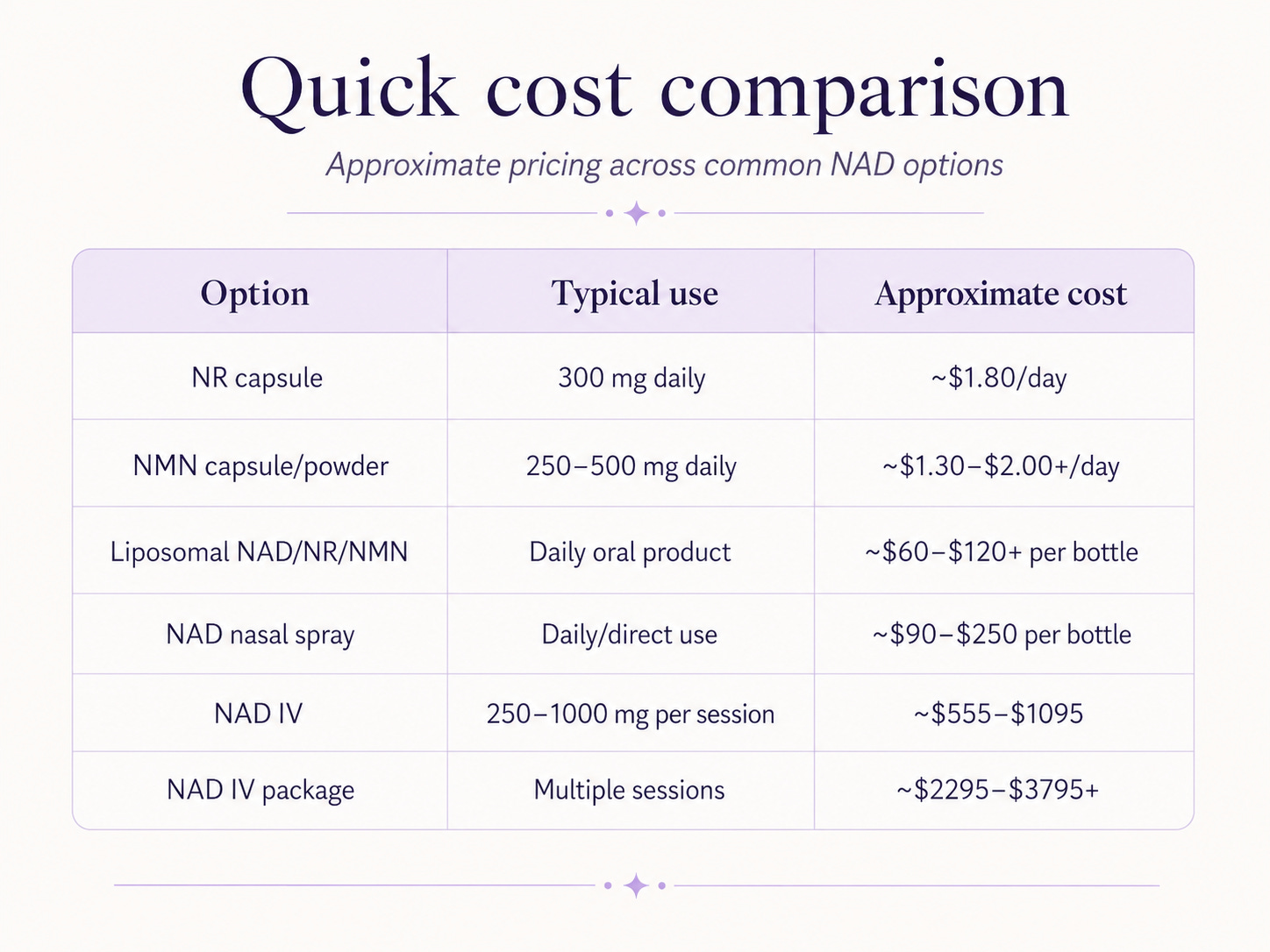
NR is one of the better-studied oral options. Human studies have used doses including 100 mg, 300 mg and 1000 mg per day, with 300 mg daily being a common commercial dose. One Australian pharmacy-listed NR product costs around $54 for 30 capsules, or about $1.80 per day.
NMN is also widely marketed. Human studies commonly use doses around 250–600 mg daily, with many consumer products sitting around 250–500 mg daily. Depending on the brand and dose, NMN often costs around $40–$100+ per bottle, or roughly $1.30–$2.00+ per day.
The science shows that oral NAD precursors can raise NAD-related markers in humans. What is less clear is whether that reliably translates into better energy, improved fertility, slower ageing or dramatic health benefits in everyday people.
Raising a marker is not the same as proving a life upgrade.
Liposomal Products
Liposomal NAD, NR or NMN products are marketed as being better absorbed because the active ingredient is packaged in tiny fat-like particles. The idea makes sense in theory, and some delivery systems may improve absorption.
The problem is that “liposomal” does not automatically mean clinically proven to work better in humans. Many products cost around $60–$120+ per bottle, so this is one of those areas where the delivery system may be promising, but the marketing is currently louder than the outcome data.
Nasal Sprays
NAD nasal sprays are marketed as a way to bypass the gut and deliver NAD more directly. Some clinic products are sold as 30- to 60-day supplies and may cost around $90–$250 per bottle, or roughly $1.50–$4.20 per day depending on the product.
The practical issue is standardisation. Dose per spray, storage requirements, absorption and product quality can vary. Some need refrigeration. Some have short expiry windows. Some are compounded through clinics.
Sprays sound convenient and slightly futuristic, but they are not automatically superior.
They are, however, excellent at making you feel like you are doing advanced biochemistry in the bathroom.
IV NAD
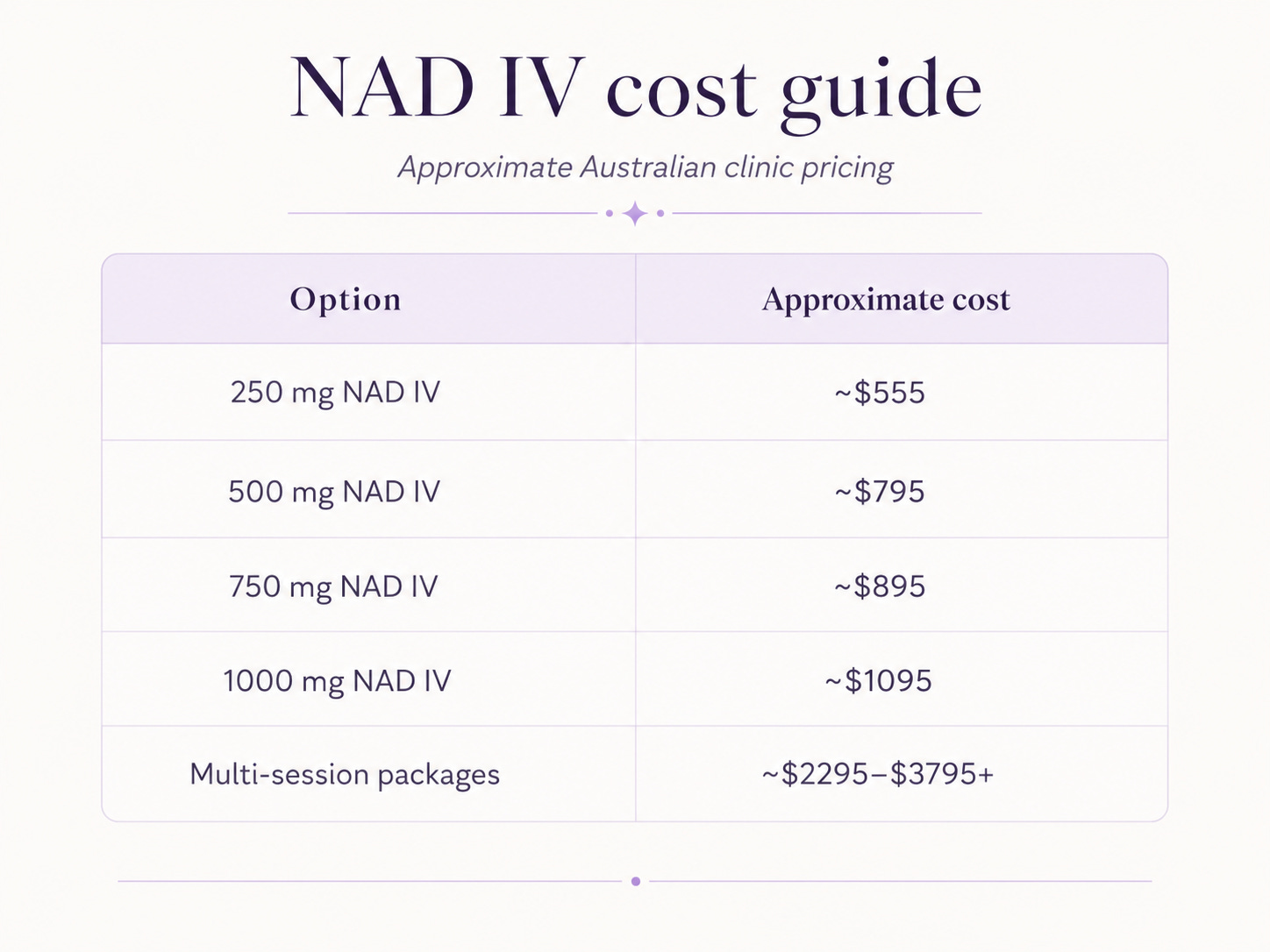
IV NAD is the premium wellness-clinic option. It usually involves sitting in a clinic while NAD is infused slowly through a drip. Advertised doses often range from 250 mg to 1000 mg, and infusions may take 2–4 hours, depending on dose and tolerance.
Australian pricing looks roughly like this:
IV delivery bypasses digestion, but that does not automatically mean it produces better long-term outcomes for the average healthy person. It is also more invasive, more expensive and comes with practical risks like cannulation, vein irritation, nausea, cramping, light-headedness and infection risk.
The question is not whether it gets into the bloodstream. It does.
The better question is whether the extra cost and invasiveness translate into better meaningful outcomes. At the moment, that answer is not settled.
What Does a Normal Routine Usually Look Like?
A low-chaos approach usually means choosing one product, using it consistently for a defined period, and tracking whether anything changes. For oral products, that might look like NR around 300 mg daily or NMN around 250–500 mg daily, often trialled for 8–12 weeks.
Useful things to track include sleep, energy, training recovery, brain fog, headaches, gut symptoms, mood and resting heart rate if available. Taking something for three days and declaring your mitochondria reborn is not exactly data.
Stacking multiple products makes things harder to interpret. NR plus NMN plus spray plus liposomal sachets plus IV therapy plus a mushroom coffee because a podcast man said “cellular optimisation” is not a science-based routine. It is a very expensive personality crisis.
Who Should Be Cautious?
This is not a casual “everyone should try it” category. Extra caution is needed during pregnancy, breastfeeding, fertility treatment, cancer treatment or cancer history, complex medication use, immune compromise, and liver, kidney, metabolic or neurological disease.
The cancer caution is not because NAD “causes cancer.” That would be too simplistic. It is because NAD is involved in cellular metabolism, repair and survival pathways. In certain contexts, especially where abnormal cells are already present, pushing those pathways becomes a more complex medical/ clinican conversation.
This is definitely not TikTok advice territory.
The Practical Takeaway
Oral NR and NMN are the simplest and cheapest options, and they have human data showing they can raise NAD-related markers. Liposomal products and sprays may have delivery advantages, but the evidence is less clear. IV NAD is the most expensive and invasive option, and it is not clearly proven to be superior for the average healthy person.
This is where wellness marketing often blurs the line between biologically plausible and clinically proven. The hard part is not finding an NAD product. It is working out which claims have evidence behind them, and which ones are just expensive confidence.