Read time: 5 minutes
Red light therapy has officially moved from niche biohacker corner to mainstream wellness shelf.
It is in beauty clinics, recovery rooms, dermatologist offices, gym studios, podcast ads, celebrity skincare routines and Instagram campaigns that somehow know exactly when you are tired, puffy, inflamed, sleep-deprived and vulnerable to a $700 face mask.
The claims are everywhere: better skin, less pain, faster recovery, improved sleep, more energy, better mitochondria, healthier ageing and, depending on the brand, a life that looks suspiciously like a hotel spa at golden hour.
Some claims are legitimate. Some are a stretch. And some of it is just a very expensive lamp wearing a wellness halo.
So this is the practical guide.
Not “does red light therapy do anything?” because we covered that in the deep dive.
The next question is more useful: if an everyday person actually wanted to try it, what should they look for, what should they avoid, and where does spending money make sense?
The realistic verdict
Red light therapy is most convincing for skin, reasonably interesting for local pain, potentially useful for muscle recovery in some situations, and much less convincing as a standalone sleep, hormone, fertility, fat-loss or longevity tool.
For the latter, the marketing appears to have run much further ahead than the evidence.
For skin, the evidence is strongest around improving photoageing, fine lines, skin texture, redness, collagen-related pathways and wound-healing support, especially when red and near-infrared wavelengths are used consistently over time. A good overview of the skin evidence is this 2024 review on photobiomodulation and dermatology, and this 2023 systematic review looked specifically at LEDs in skin therapy.
For pain, the evidence is more condition-specific and dose-dependent. Knee osteoarthritis, for example, has some supportive data, but the effect depends on wavelength, dose, treatment points and consistency rather than simply “shining red light somewhere sore.”
For exercise recovery, there is some supportive evidence, particularly in athletic settings, but again the details matter: where the light is applied, how much energy is delivered, and whether it is used before or after training can change the outcome.
For sleep, the evidence is still too thin to justify buying a device mainly for that reason.
That is the first filter.
Before buying anything, ask: what am I actually buying this for?
Because the best device for facial ageing is not necessarily the best device for knee pain, and the best device for knee pain is probably not the best device for whole-body recovery.
This is where a lot of people get caught. They do not buy based on use case. They buy based on glow.
The three numbers that matter
Red light therapy products love a specification sheet.
Wavelengths. Irradiance. Power density. LED count. Beam angle. Pulsing. Nanometres. Joules. Sometimes enough technical language to make a skincare mask sound like it was built for space travel.
But for an everyday buyer, there are really three things worth understanding: Wavelength, Irradiance and Dose.
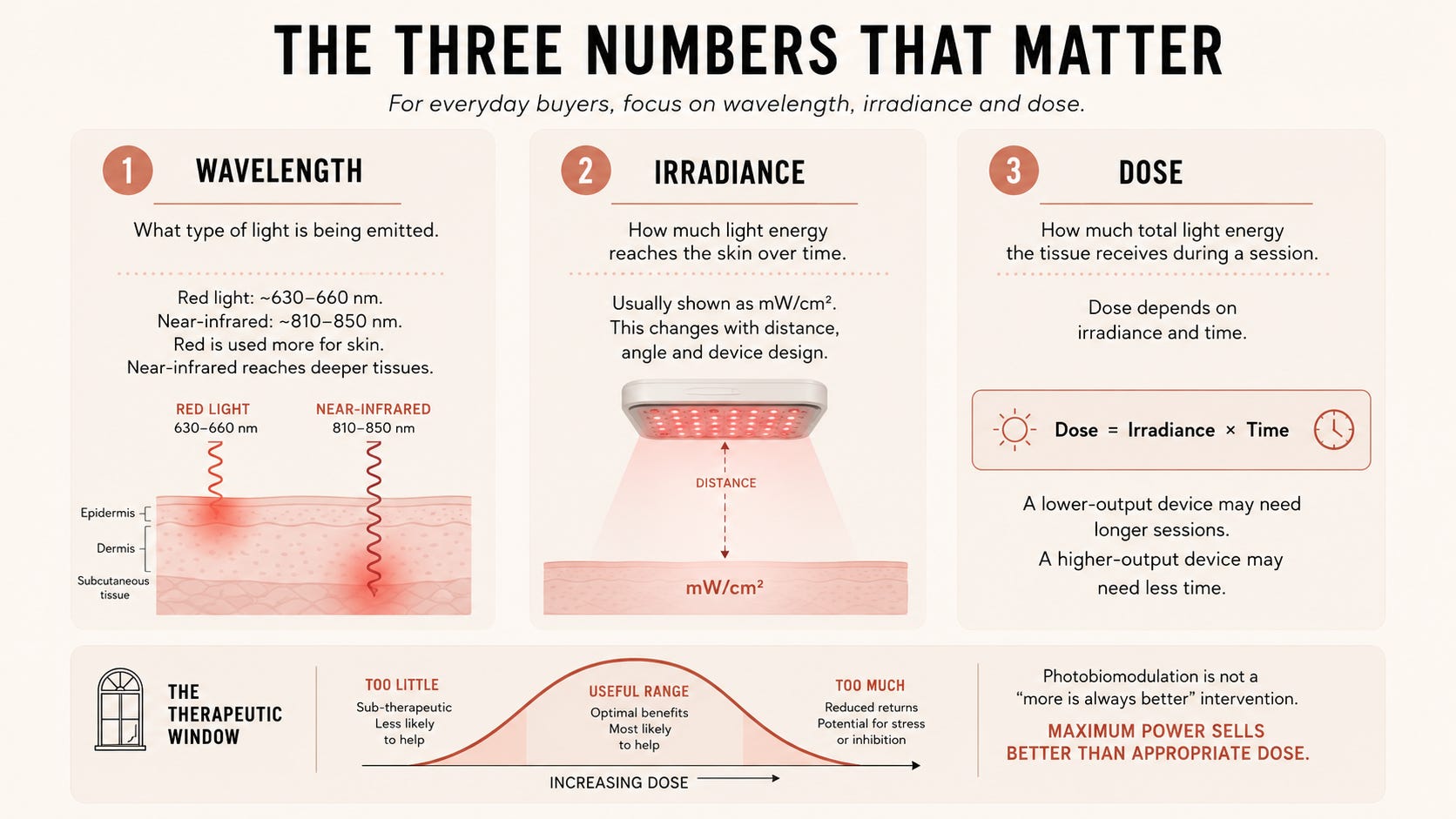
Wavelength tells you what type of light is being emitted. Irradiance tells you how much light energy is reaching an area over time. Dose tells you how much total light energy the tissue receives during a session.
This matters because red light therapy is not a “more is always better” intervention.
Photobiomodulation appears to follow a therapeutic window, which means too little may do very little, the right amount may be useful, and too much may stop being helpful.
Deeply inconvenient for marketing, because “maximum power” sells better than “appropriate dose.”
Wavelength: what colours should you actually care about?
The two most useful categories are red light and near-infrared light.
Red light is usually around 630–660 nm, and near-infrared light is usually around 810–850 nm, with 830 nm and 850 nm commonly used in consumer devices.
Red light is generally used for more superficial targets, which is why it is common in skin devices. Near-infrared light penetrates more deeply and is often included in devices aimed at joints, muscles, recovery and deeper tissue targets.
For most everyday buyers, a good device will usually include some combination of 630/633/660 nm red light and 830/850 nm near-infrared light.
You do not need seven colours.
You do not need a rainbow.
You need wavelengths that match the evidence.
Blue light can be useful for acne, especially in devices designed for blemish-prone skin, but that is a slightly different category. Amber, green, purple and multi-colour modes may sound more advanced, but for general anti-ageing and recovery goals, the evidence is much less established than the classic red and near-infrared wavelengths.
More colours does not automatically mean better results.
Sometimes it just means a better product page.
Irradiance and dose: why “strongest” is not always best
Irradiance is usually listed as mW/cm², which means milliwatts per square centimetre.
In simple terms, it tells you how much light power is reaching your skin at a given distance. A device might say it delivers 100 mW/cm² at six inches, which sounds impressive until you realise that not all brands measure irradiance the same way.
Some measurements are taken very close to the device. Some are taken at unrealistic distances. Some are measured using tools that can overestimate LED output.
This does not automatically make the device useless.
It just means you should not base your buying decision around the biggest number on the box.
Dose is the part most people skip, but it is the part that matters.
The basic idea is simple: dose = irradiance × time.
If the device has low irradiance, you need more time to reach a meaningful dose. If the device has high irradiance, you need less time. This is why blindly using every device for “10 minutes” does not make sense across every product.
Ten minutes with a low-output face mask is not the same as ten minutes close to a high-output body panel.
The goal is not to blast your mitochondria into submission. It is to apply an appropriate dose consistently enough to see whether your skin, pain or recovery responds.
For anyone who wants to go deeper, the World Association for Photobiomodulation Therapy has dosing recommendations for clinical use, and this practical red light dosing guide explains how irradiance and time interact in consumer devices.
Device type: what should you actually buy?
The best red light device is not the “best” device.
It is the device that matches the body area you will actually treat, often enough, without making your life annoying.
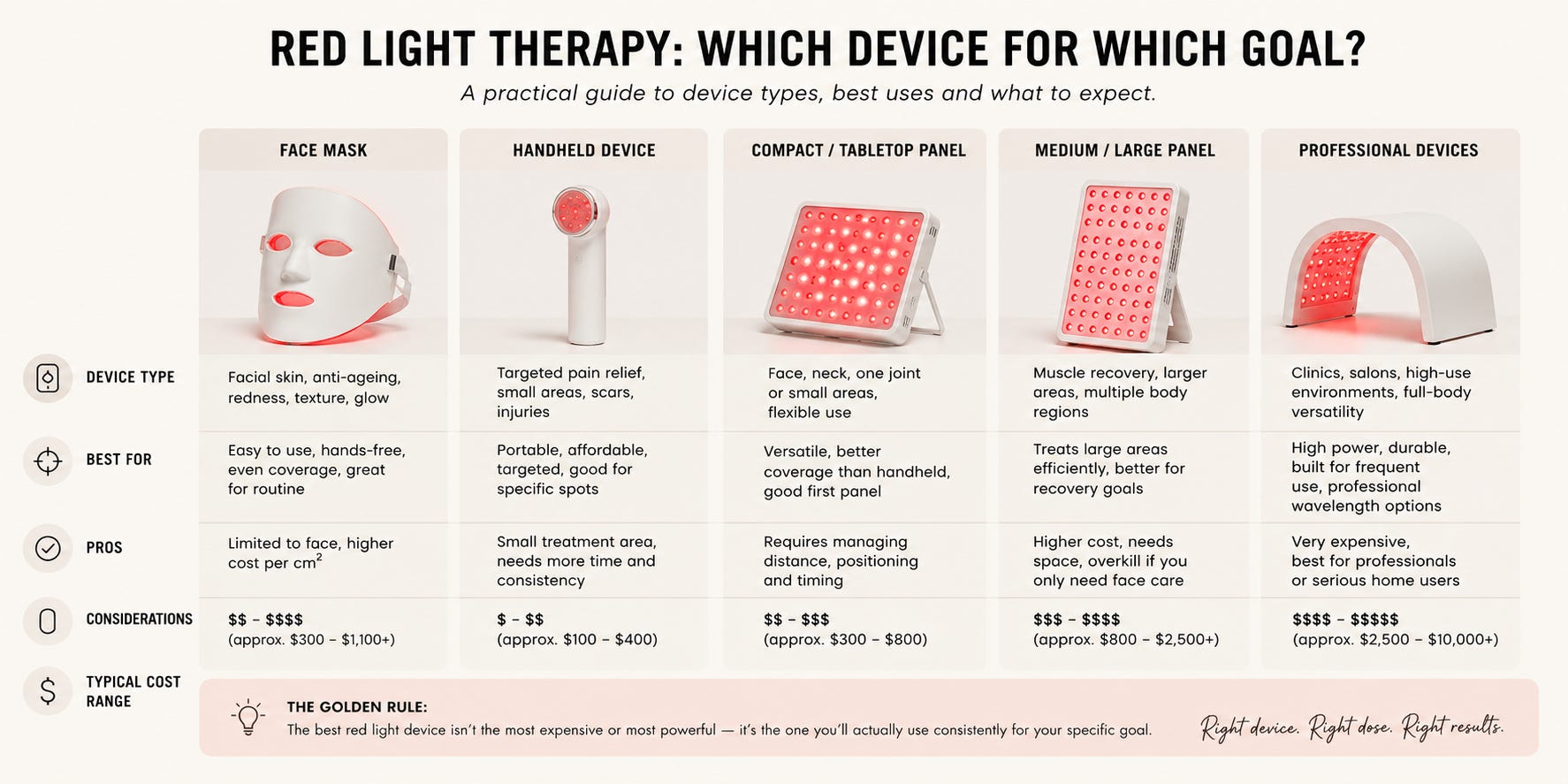
If your goal is facial skin, a mask is usually the easiest option. It sits at a fixed distance, covers the face evenly, and is easy to use while making coffee, folding washing or pretending you are about to start a ten-step skincare routine when really you are just trying to look less tired.
For facial ageing, redness, texture, dullness and general skin quality, look for a mask using around 633 nm red light and 830 nm near-infrared light, or something close to that.
For Australian buyers, CurrentBody Australia and BON CHARGE Australia are easy examples of premium LED masks with Australian-facing stores. Omnilux is also widely discussed internationally and has a strong reputation in the LED mask space, but I would check Australian pricing, warranty, shipping and returns before buying directly.
A face mask that lives in a drawer is not skincare.
It is an expensive guilt object.
If your goal is one joint, one sore spot or one small area, a handheld device or compact panel makes more sense. This is the category for someone who wants to treat a knee, elbow, wrist, Achilles, jaw, small scar or one local area.
A compact tabletop panel is usually more versatile than a handheld because you can use it for your face, neck, one joint, one shoulder or one muscle region. For compact panels, the principle matters more than the brand: look for clear 660 nm and 850 nm specifications, stated irradiance at a real treatment distance, Australian shipping, warranty support and clear safety guidance.
Brands like Hooga are often discussed internationally in the simpler, value-focused panel category, but I would treat them as a specification example rather than an automatic Australian buying recommendation.
If your goal is muscle recovery or larger body areas, you are now in panel territory. For quads, hamstrings, calves, back, shoulders, glutes or larger recovery goals, a small handheld device becomes impractical very quickly.
This is also where people overbuy.
A full-body panel looks impressive, photographs beautifully, and makes your bedroom look like an elite recovery lab. But if you only wanted better skin texture and an occasional sore knee treatment, you may not need a glowing red door.
Large panels make the most sense for athletes, heavy exercisers, people with repeated body-area use, or households where more than one person will use the device consistently.
They are less compelling for someone who mostly wants facial skin results.
If your goal is sleep
I would not buy one for this alone.
There are small studies and plausible mechanisms around light exposure, circadian biology and melatonin, but the current evidence does not justify the way sleep claims are often marketed in red light therapy products.
Could some people sleep better because they use it as a calming ritual? Possibly. Could red light be less disruptive than blue-rich light before bed? Yes.
But that is different from saying a red light therapy panel is an evidence-backed sleep treatment.
For sleep, the boring things still matter more: morning light, consistent wake time, less bright light at night, caffeine timing, room temperature, stress and the general chaos of being a human with responsibilities.
What is worth paying for?
Pay for evidence-aligned wavelengths, clear technical specifications, build quality, safety information, warranty, customer support, and coverage if you truly need to treat a large area.
Do not pay extra just because a device says “biohacking,” “cellular optimisation,” “anti-ageing breakthrough,” “mitochondrial upgrade” or “longevity support.”
Those words are doing emotional labour.
They are not specifications.
At the budget end, small handheld devices, bulbs and basic spot-treatment tools may be under a few hundred dollars, but coverage is limited and quality varies.
In the middle, compact panels and face masks are where most everyday buyers should probably stay.
At the premium end, you get larger panels, stronger construction, more controls and broader treatment areas, which may make sense if you genuinely need body coverage or multiple people will use the device.
At the professional end, devices like Dermalux Flex MD or Celluma PRO are designed more for clinics, salons, treatment rooms or very committed home users.
The biggest cost mistake is buying the device that matches your fantasy routine instead of your actual routine.
Good value is the device you will use correctly for the thing you actually bought it for.
My practical buying checklist
Before buying, I would want to know the wavelengths, the irradiance at a clear distance, the recommended treatment time, the eye safety guidance, the return policy and the warranty.
I would also want the company to explain contraindications clearly, especially around photosensitising medications, light-sensitive conditions, eye disease, active cancer concerns, pregnancy, and use over compromised skin. CurrentBody has a useful example of a consumer-facing LED contraindications page, which is the kind of information I would want to see before buying any device in this category.
I would also check whether the device is easy to clean, easy to store, and easy to use without turning my house into a wellness bunker.
Because no one talks enough about friction.
The best protocol is useless if you hate using the device.
The Claritti verdict
Red light therapy is not nonsense.
It is also not magic.
It sits in the increasingly common category of wellness tools where the underlying science is real, the clinical evidence is mixed but promising in specific areas, and the marketing is absolutely doing laps around the data.
For skin, I think it can be a reasonable investment if you choose a good device and use it consistently.
For local pain, I think it is interesting, but it needs better dose discipline than most consumer marketing admits.
For muscle recovery, I think it may be useful for people training hard enough to justify the cost.
For sleep and longevity, I would keep my money in my pocket unless another more evidence-backed goal already justifies the purchase.
So if you are red light curious, start boring. Choose the body area. Choose the evidence-backed wavelengths. Check the real specifications. Buy the smallest device that solves the actual problem.
Then use it consistently enough to know whether it works for you.
Not everything that glows is a breakthrough. However, with the right device, the right dose and the right expectation, there is actually some hope for us here.