Read time: 7 minutes
The Clarity Preview
By the end of this guide, you’ll know:
• Which type of retinoid might suit your skin
• What matters more than the percentage on the label
• Which marketing claims I’d ignore
• Where people commonly waste their money
If this week’s deep dive taught us anything, it’s this:
Buying a retinoid is very similar to buying olive oil. Two bottles can look almost identical, say all the right things on the label, and cost a fortune. One is formulated well, while the other has quietly degraded under bright lights for six months.
The percentage on the bottle is only part of the story.
Let’s make this simple.
First, decide which person you are.
“I want the best evidence.”
Buy prescription tretinoin.
It’s still the benchmark, backed by decades of trials and real collagen remodelling. It’s also surprisingly affordable in Australia. You’ll need a prescription, but telehealth has made that much easier than it used to be.
In Australia: tretinoin is now available in two main forms:
Retrieve Cream 0.05%
Available from Australian pharmacies with a valid prescription.
Compounded tretinoin
Compounding pharmacies can prepare different strengths and cream bases when the standard commercial option is not suitable. Some people begin with 0.025% or 0.05%, depending on their skin and their clinician’s advice.
Higher is not automatically better.
The evidence does not support the idea that 0.1% is meaningfully more effective for ageing. Research comparing different tretinoin strengths has found that stronger formulations may produce more irritation without delivering meaningfully better cosmetic results.
A product that makes your skin so uncomfortable that you stop using it is not the superior product.
“I don’t want a prescription.”
Buy a retinal.
It’s one conversion step away from becoming retinoic acid and offers an appealing middle ground between standard retinol and prescription tretinoin.
My pick: Medik8 Crystal Retinal.
Not simply because it sits in the premium section of the beauty store, but because the range is designed around stabilised retinal and offers several strengths.
Crystal Retinal 1 is a reasonable starting point if you are new to retinoids or have sensitive skin. If you already tolerate retinol comfortably, Crystal Retinal 3 or 6 is a more suitable progression.
You will often see claims that retinal works “11 times faster than retinol.”
That claim is based largely on the difference in conversion steps, rather than clinical trials showing that one finished product produces visible results exactly 11 times faster than another.
It is a plausible chemistry-based claim. It is not the same as proven clinical superiority.
“I’m completely new to this.”
Start with a retinol, and start at a lower concentration.
Consistency beats intensity. I’d rather see someone use a gentle retinol for two years than quit tretinoin after two weeks because their face feels like sandpaper.
There are plenty of reasonable beginner formulations available in Australia. One accessible option is La Roche-Posay Retinol B3 Serum (~ $65 AUD), which combines retinol with niacinamide and is widely stocked at major pharmacies.
A lower-cost option is The Ordinary Retinol in Squalane (~$16 AUD). The squalane base may feel gentler, but the formula requires more careful storage. Once opened, the brand advises refrigerating it and using it within three months.
The Ordinary also sells Granactive Retinoid 2% Emulsion, but that percentage cannot be compared directly with a retinol percentage. It uses hydroxypinacolone retinoate, or HPR, and has a much smaller evidence base. It may be an option for people prioritising tolerability, but “2% Granactive Retinoid” does not mean “2% retinol.”
“My skin hates everything.”
Don’t force a retinoid.
Consider whether it is the right first step for your skin.
Azelaic acid is generally well tolerated and has genuine evidence for concerns including pigmentation, breakouts and uneven texture.
If your skin barrier is already irritated, building a simple routine around gentle cleansing, ceramides, moisturiser and sunscreen may be more useful than adding another active ingredient.
You can always introduce a retinoid later.
There is no medal for having the most actives in your bathroom cabinet.
And please don’t forget sunscreen
Every morning.
The retinoid helps repair some of the effects of sun damage. Sunscreen helps prevent more of that damage from occurring.
The retinoid builds.
The sunscreen protects what is being built.
One without the other is an incomplete strategy.
A note on the product recommendations
I have no financial relationship with any of the brands mentioned in this guide.
There are no affiliate links, sponsorships or gifted products influencing these recommendations.
The products are included because they are accessible in Australia and provide useful examples of different retinoid options, formulations and price points.
This is also general information rather than personal medical advice. A GP or dermatologist can assess your skin, medical history and treatment goals before recommending a prescription product.
Ignore the percentage for a minute
If you only remember one thing from this guide, make it this:
Packaging matters almost as much as the ingredient
Retinol dislikes light, oxygen and heat, which makes a clear glass dropper bottle a slightly strange career choice.
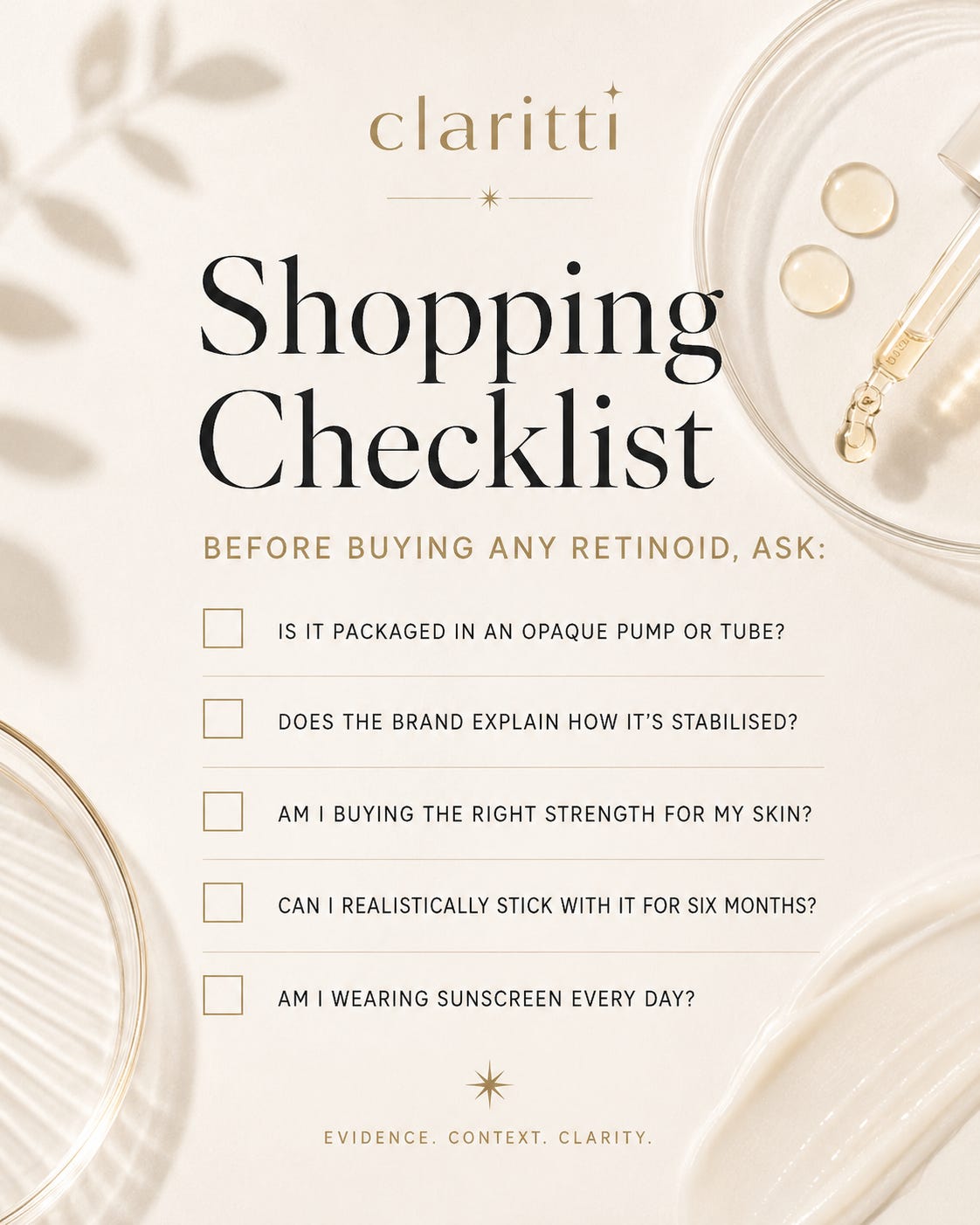
When shopping, look for:
✓ Opaque pumps or tubes
✓ Packaging that limits repeated exposure to air
✓ Encapsulated or stabilised retinol
✓ Brands that explain how the active ingredient is protected
✓ Storage instructions you can realistically follow
Less exciting?
Absolutely.
More important?
Also yes.
Three marketing claims I’d politely ignore
“Medical grade”
There is no universally accepted definition of medical-grade skincare.
It is often used to imply that a product is stronger, more scientific or more effective than ordinary cosmetics.
Sometimes the formulation may be excellent. However, the phrase itself proves very little.
“Clinically proven”
Great.
Where is the study? Was it published? Was it independently conducted? Was the final product tested, or only one ingredient inside it?
“Clinically tested” can describe anything from a published controlled trial to a small study commissioned by the company selling the product.
“2% Retinoid Complex”
Two percent of what?
Retinol? Retinal? An ester? A blend of several ingredients?
A large percentage on the front of a bottle can look impressive while telling you very little about the amount of active retinoid it contains.
Five mistakes I see all the time
❌ Starting with the highest strength
❌ Using it every night from day one
❌ Skipping sunscreen
❌ Assuming irritation means it is working
❌ Giving up after three weeks
Retinoids reward patience far more than bravery.
The routine I’d actually recommend when starting
Morning
• Gentle cleanse or rinse, depending on your skin
• Moisturiser
• Broad-spectrum sunscreen
Evening
• Cleanser
• Pea-sized amount of retinoid
• Moisturiser
Start slowly. Two nights a week is plenty for many beginners, and there is no prize for reaching nightly use first.
If you are prone to irritation, use the sandwich method by applying moisturiser before and after the retinoid.
That is it.
Your skin probably does not need a twelve-step routine.
Neither does your wallet.
The Clarity
Buying a retinoid shouldn’t feel like decoding a wine list.
The strongest product isn’t always the best product, the highest percentage isn’t always the most effective, and the most expensive bottle isn’t guaranteed to outperform the one next to it.
Look for good evidence, sensible formulation, and protective packaging. Then use it consistently enough to give it a chance.
Because the best retinoid is almost never the one with the cleverest marketing.
It’s the one that’s still active when it reaches your skin, and gentle enough that you keep using it.